*

TWITTER | @martingruner

    1.11.09

    Crimes of War

    Despite being written in semi-legalese, The Goldstone report [warning: 600-page PDF] never ceases to be an interesting read. I keep finding these dry little statements of fact that are either heartbreaking or pithy wordings that somehow encapsulate the breadth of the crimes committed. Here are a couple of the ones I found today.

    First off, the account of the shelling of the United Nations Relief and Works Agency (UNRWA) compound in the southern Rimal area of Gaza City, on January 15th of this year. It's interesting reading. You find it on page 162 to 174 of the PDF.
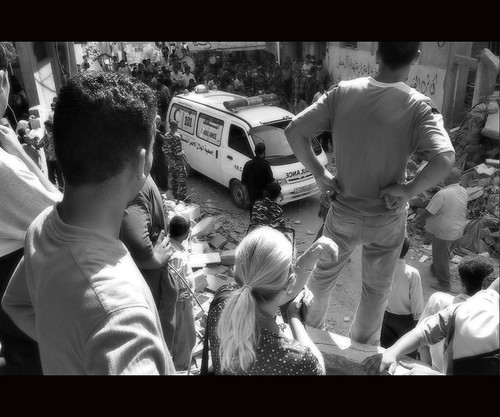

    (photo by Flickr user blhphotography CC-BY)

    Basically what happened here was that the Israeli forces, despite having GPS coordinates and despite at least forty telephone calls from UN leaders in Gaza and Palestine to Israeli authorities through established channels on that morning and provable contact between those authorities and the field personnel of the army, they repeatedly shelled a United Nations compound where 700 Palestinians were taking refuge, with illegal white phosphorous grenades.

    The report is blistering in its dismantling of the Israeli arguments defending this attack, summed up in this paragraph:
    The question then becomes how specialists expertly trained in the complex issue of artillery deployment and aware of the presence of an extremely sensitive site can strike that site ten times while apparently trying to avoid it.
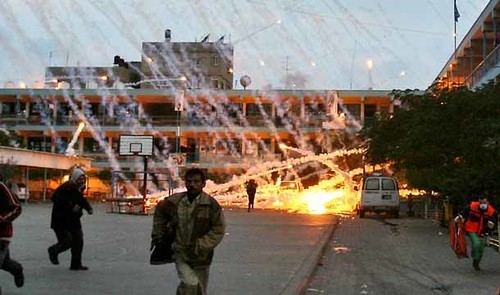
    They also note that the area struck by the shells was within one football pitch of one another, and coincidentally, the incendiary weapons all happened to strike near the enormous fuel depot of several hundred thousand litres of fuel on the site. The entire site was two football pitches in size.


    Another paragraph that struck me deals with the equally horrific attack on the Al-Quds hospital, in direct violation of Geneva Convention IV §18 and §19. The Israeli military also used illegal white phosphorous shells here. The story that really struck me was this one:
    596. The doctors with whom the Mission spoke all occupied senior positions but also witnessed the events that occurred throughout that day. The Mission was impressed with their objectivity and the genuine distress several of them showed at being unable to help or protect the sick and wounded who had come to the hospital. Throughout that day many of the staff, including the doctors, took exceptional risks to stop fire spreading, including by removing white phosphorous wedges from near diesel tanks. One doctor in particular showed remarkable courage. He left the hospital to drive an ambulance through artillery shelling as he sought to bring an eight-year-old girl to al-Shifa hospital for treatment which he was no longer able to provide in al-Quds. Having taken the girl there, he drove back to the hospital in the same conditions to continue assisting the efforts to fight the fires.
    The 8 year-old girl, who had been shot in the jaw by an Israeli sniper (since the snipers prepare their shots, presumably while she was engaged in launching terror rockets against Israeli settlements or other military activities), later died from her injuries. The report concludes that she would not have died had the attack on the hospital not occurred and considers the Israeli military responsible for her death.

    *


    Longtime readers of this blog have probably noticed that I will occasionally write about human rights, international humanitarian law, crimes of war or crimes against humanity, which are all topics I've been interested in since at least high school. For two years in high school and on and off afterwards I was an active member of my school Amnesty Youth group. It was a great time, and I learned most of what I know about international law and human rights -- which isn't a lot compared to most of the wonderful activists I met in Amnesty -- during those two years. Then, just as I was starting university and entering my last time in Amnesty, I bought a book called Crimes of War: What the Public Should Know. I think more people should do themselves the favour of reading that book. It is by far the best introduction to the topic I know of.

    If I'm completely honest, I pretty much bought it impulsively because it's an uncannily well-designed, physically beautiful book: it is printed on high-quality smooth paper and bound in a strange, tall and narrow format, with a gorgeously simplistic cover and a magazine-like layout. It is thoroughly illustrated with stunning black and white photographs from war zones all over the world taken by some of our time's leading photojournalists, including many from the Magnum group.

    But the book turned out to be a remarkable book which I am constantly coming back to. It is basically an illustrated A to Z guide to war crimes and international humanitarian law written by legal scholars and other experts. I know that sounds dry, but it is quite simply relentlessly readable. I read it from cover to cover (it is ingeniously laid out so that if you read it in this order, it proceeds more or less from basic rules to more complex issues). It is meant as a guide for people requiring a basic working knowledge of the laws of war. In this day and age, I'm afraid that means everyone who follows the news, but particularly journalists, commentators, teachers, activists, aid workers, anyone working with international issues and politicians.

    I still find myself constantly returning to this book to look things up -- if my brother hasn't stolen it, that is -- and refind my footing when Israel or the US or some other beligerent power tries to relativise what they have done or try to give rhetorical cover to their crimes. It is one of the most useful books I have ever read, and while I have read many other books later on these topics, this one must be the most influential one. I have made a habit of recommending it to everyone over the past couple of years.

    So imagine my delight when I discovered yesterday that the entire book has been made availably online for free along with numerous other extra materials, commentary and articles not in the book.

    Though you will have to miss out on the great layout on the web, I hope that at least a few of my literally tens of readers will take the time out to read a few articles or maybe even the whole thing over a few days. It's a book that taught me a lot proportional to the amount of work I had to put into it. I can only second the blurb on the back, from W. Pfaff of the International Herald Tribune: "A reference work that has no counterpart ... civilization is in debt to all [its contributors]."

    Labels: , , , , ,

    26.10.09

    What came first? The chicken — or Protocol I Additional to the Geneva Conventions of 12 August 1949?


    Commenter Alex thinks my concern about the killing of chickens belonging to Palestinian civilians during the bombing of Gaza doesn't really capture the gravitas of the Gaza situation:
    with all do respect to the atrocity of killing 31,000 chickens: it is horrible and unmoral but it is not a humanitarian crime or a crime against humanity. We can protest, but we can't trial people for that
    And since I think this might be a common misconception, I did some legwork and dug up the relevant legal points for you, gentle reader.

    You might not think that killing chickens could be a crime against humanity, but it can be, and in this case, it is.

    What follows is my reply to Alex, lightly edited for clarity:

    As to your last point I must disagree in the strongest possible terms. International Humanitarian Law is crystal clear on this matter. The demolition of the chicken farm was completely and obviously illegal. It was a war crime, and quite possibly a crime against humanity.

    The first and most clear violation is of article 52 of Additional Protocol I to the Geneva Conventions, ratified in 1977. Which, notably, Israel has not ratified. However, it is now accepted throughout the world as being customary international law, and the IDF is completely bound by it.

    Art. 52 of Protocol I states that
    1. Civilian objects shall not be the object of attack or of reprisals. Civilian objects are all objects which are not military objectives as defined in paragraph

    2. Attacks shall be limited strictly to military objectives. In so far as objects are concerned, military objectives are limited to those objects which by their nature, location, purpose or use make an effective contribution to military action and whose total or partial destruction, capture or neutralization, in the circumstances ruling at the time, offers a definite military advantage.

    3. In case of doubt whether an object which is normally dedicated to civilian purposes, such as a place of worship, a house or other dwelling or a school, is being used to make an effective contribution to military action, it shall be presumed not to be so used.
    I don't seem to remember chickens having military applications, unless of course the Palestinians have somehow gotten hold of a "Blue Peacock" nuclear device. And foodstuffs that are also (indeed, primarily) used for civilian populations are not legitimate targets.

    Secondly, this is also a blatant violation of article 55 of the fourth Geneva Convention, ratified in 1949, and which Israel HAS ratified. Article 55 states that:
    To the fullest extent of the means available to it, the Occupying Power has the duty of ensuring the food and medical supplies of the population; it should, in particular, bring in the necessary foodstuffs, medical stores and other articles if the resources of the occupied territory are inadequate.

    The Occupying Power may not requisition foodstuffs, articles or medical supplies available in the occupied territory, except for use by the occupation forces and administration personnel, and then only if the requirements of the civilian population have been taken into account. Subject to the provisions of other international Conventions, the Occupying Power shall make arrangements to ensure that fair value is paid for any requisitioned goods.

    The Protecting Power shall, at any time, be at liberty to verify the state of the food and medical supplies in occupied territories, except where temporary restrictions are made necessary by imperative military requirements.
    In case you were wondering, "imperative military requirements" does not include "because we've blocaded Gaza again", "because we're busy bombing the civilian population" or "because we felt like it".


    The definition of "crimes against humanity" contained in the Rome Statute of the ICC is basically really bad things – including war crimes – being done in a systematic way. A system of oppression which derives a people of basic neccesities easily falls under this heading. The destruction of the chicken coops may have been tougher on the chickens than the people in the area. But it was also beyond a shadow of a doubt a crime of war and almost certainly part of a system of abuse which constitutes a crime against humanity.


    *

    (all photos by Flickr user Rafahkid, CC-BY-SA. The photos do not display the destruction of this particular chicken farm, but of another destruction of a chicken farm. You could almost think they were targeting chicken farms intentionally! Rafahkid has more photos of this incident in his photostream.)

    Labels: , , , , ,

    27.4.09

    SERE

    Extremely interesting interview on torture with a conscientious interrogator who got very unpopular in Iraq, at NPR:
    What you're describing is taking techniques that U.S. military personnel had been trained to resist ... [and] using those very techniques on the people the U.S. was detaining in Iraq?

    Exactly, and I think a key point that your listeners need to understand, so they can grasp the gravity of the situation, is that the primary objective of that approach to interrogation was not truth … but somebody's political truth. In the Korean War, they actually compelled some of our pilots to admit to dropping chemical weapons on cities and so forth, when in fact that didn't happen. Now, that stands in stark contrast to intelligence interrogation, where the overriding objective is provide timely, accurate, reliable, comprehensive intelligence.

    And these harsh interrogation methods had been used by the Soviets and the Chinese to get people to say things that weren't true?

    That's true. And it's not just harsh physically, but I think the element that was more persuasive was their ability to induce what is known as debility, depression and dread through emotional and psychological techniques that profoundly altered somebody's ability to answer questions truthfully even if they wanted to. It truly undermined their ability to recall, so therefore it would call into question its efficacy in an intelligence-based interrogation.
    *
    I am reminded of a passage in William Gibson's latest novel, Spook Country. Gibson apparently knew all this already. He posted this passage on his blog (sidebar), back in September 2006, so I'll repost it here, even though the published version is slightly different:
    Tito watched the old man fold the copy of the New York Times he’d been reading. The light was going. Fading above this other ocean, the Pacific, which Tito had never seen before.

    “I remember proofs of a CIA interrogation manual, something we’d been sent unofficially, for comment,” the old man said. “The first chapter laid out the ways in which torture is fundamentally counterproductive to intelligence. The argument had nothing to do with ethics, everything to do with quality and depth of product, with not squandering potential assets.” He removed his gold-rimmed glasses. “If the man who keeps returning to question you avoids behaving as if he were your enemy, you begin to lose your sense of who you are. Gradually, in the crisis of self that your captivity becomes, he guides you in your discovery of who you are becoming.”

    “Did you interrogate people, yourself?” asked Garreth. The three of them were seated in the back of an open jeep, the black Pelican case under Garreth’s feet.

    “No,” said the old man, “I only reviewed the product. It’s a terribly intimate process. An ordinary cigarette lighter will cause a man to tell you anything, whatever he thinks you want to hear. And will prevent him ever trusting you again, even slightly. And will confirm him, in his sense of self, as few things will.” He tapped the folded paper. “When I first saw what they were doing, I knew that they’d turned the SERE lessons inside out. That meant that we were using techniques the Koreans had specifically developed in order to prepare prisoners for show trials.” He fell silent.

    Tito heard the lapping of waves.

    Labels: , , , , , ,

    26.1.09

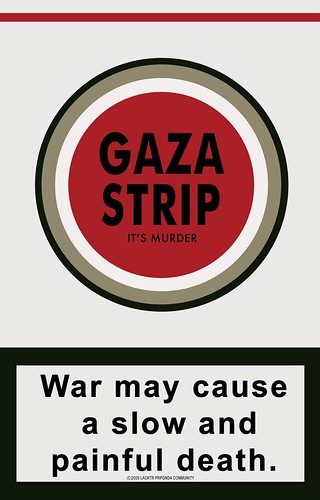
    Unlucky strike

    Unlucky Gaza

    This little t-shirt motif (go to the Flickr link for a larger size) comes to us courtesy of the Lacktr Prpgnda Community.

    Labels: , , ,