*

TWITTER | @martingruner

    2.6.10

    Vi snakket om Gaza

    Idag skrev kritiker Bjørn Gabrielsen i sin avis, Dagens Næringsliv, en merkverdig artikkel som har fått en del oppmerksomhet og vunnet mye åtgaum — gudene vet hvorfor — i hovedstaden. Hovedtesen er at "Erlend Loe og Henning Mankell har gjort seg til totalitære bevegelsers gisler i tro på at de støtter en god sak."

    Som jeg sa sist jeg skrev svar til noe Bjørn hadde skrevet, så synes jeg han er en utvetydig fin fyr, en klok mann og på norsk litteraturkritikks A-lag. Jeg fikk en del merkelig surmaget kritikk for at jeg sa dette – men det tåler å gjentas. Men i disse spørsmålene utviser han en interessant blanding av analytisk evne, rasjonalitet og skarpsinn koblet med en merkelig ensidighet i argumentasjonen, en slags epistemisk avsondring der all analysen kun gjelder når argumentene går den ene veien, men ikke den andre.

    Dette fører til en mangel på prinsipiell tenkning som jeg synes har vært symptomatisk for en del av den israelvennlige høyresiden og den kulturhaukete venstresiden (Christopher Hitchens-venstre). Denne holdningen er farlig og ser ut til å spre seg. Jeg håper den stanser før den ødelegger for norsk utenrikspolitikk. Jeg kommer til å angripe Gabrielsens argument punkt for punkt, og ved å gjøre dette forhåpentligvis komme litt tettere inn på hvorfor jeg mener den pro-israelske siden utviser en form for moralsk og epistemisk forfall i dette spørsmålet.
    «Skam deg, Israel», sa Erlend Loe i en tale utenfor Israels ambassade mandag ettermiddag. Skamme seg bør også nordiske intellektuelle som så villig går i flokk hver gang den antiisraelske gongongen lyder.

    (...)

    Det ligger en klar etymologisk perversitet at (...) intellektuelle ofte [har] brukt sine evner nettopp til forsvar av - snarere enn kamp mot - totalitære bevegelser.

    I ettertidens kranke lys kan det være lett å glemme at tidligere tiders forfattere som så blidt omfavnet nazismen og kommunismen ikke alltid gjorde det ut fra det som føltes som onde hensikter der og da. Hamsun uttrykte ikke et eksplisitt ønske om jødeutryddelse, Sartres mål var ikke primært utsultingen av ukrainske bønder. Tvert imot ble dette århundres mest ondskapsfulle dogmer akseptert og fremmet i en forvirret tro at man var i det godes tjeneste.
    Dette er jeg helt enig i. Det er en god og klok observasjon. Derfor må jeg spørre, som jeg spurte på Twitter: Ser Gabrielsen ikke at det er sterke totalitære trekk i Israel også? En etnisk-basert nasjonalstatsfølelse, et autoritært og militaristisk styresett i kamp med en altoppslukende ytre fiende, en ignorering av grunnleggende menneskerettigheter for en underklasse, mens en overklasse nyter fruktene av deres underkastelse? Dette er definisjonen av et totalitært samfunn. Når Gabrielsen sier disse tingene så ser jeg at han er obs på hva et totalitært samfunn er (Hamas har også åpenbart sterke totalitære trekk, selvsagt, men langt mindre makt.) Men det israelske samfunnets totalitære trekk dukker aldri opp i argumentasjonen.

    La oss bruke dette avsnittet til Gabrielsen som lesemetode på resten av innlegget, som, hvis vi skal bruke samme usjenerøse lesning som han vender mot Loe og Mankell, kan leses som et forsvar for en amoralsk blokade mot Gaza som tar livet av mange hvert år, og en rekke krigsforbrytelser.
    I disse dager er det særlig Erlend Loe og Henning Mankell som i skandinavisk sammenheng spiller rollen som intellektuelle med vanvittige agendaer. Mankell deltok i «fredskonvoien» med varer til Gaza, Loe ble invitert til å være med, men takket nei i siste øyeblikk. Til gjengjeld holdt Loe tale foran Israels ambassade i Oslo på mandag. De antiisraelske demonstrasjonene verden rundt kan kalles en propagandaseier for Hamas, uansett hvor tragiske de enkelte dødsfallene er.
    Igjen: En god observasjon. Det er helt riktig at hver gang Israel utfører urettferdigheter, så stiger Hamas' stjerne på Gaza. Denne dynamikken må det være vårt felles mål å bryte.
    Loes situasjon er særlig interessant fordi han anstrengte seg på å opprettholde en viss anstendighet, ingen lett øvelse i noen som helst demonstrasjon, og slett ikke en som berører dette tema. «Jeg hater ikke Israel, og jeg støtter ikke Hamas,» sa han. Modige ord, om enn litt svake siden han rett etterpå ble avløst av Erling Folkvord som med betydelig høyere røst og noe mindre rom for tvetydigheter forlangte norsk anerkjennelse av «den lovlig valgte regjeringa på Gaza», altså Hamas.
    Ok. Stopp. Her går det galt. Vi er nødt til å anerkjenne Hamasregjeringen ikke fordi vi liker politikken deres, men fordi de er den folkevalgte regjeringen av et folk som har selvbestemmelsesrett. Ikke fordi vi synes de er gode til å styre, men fordi de representerer en demokratisk strømning i folket, som vi kan like eller mislike (jeg ville helst sett Hamas som et avsluttet kapittel i historien, selvsagt). Å tro at vi får til en løsning akkurat nå uten å anerkjenne Hamas er latterlig og urealistisk og enda en av disse dysfunksjonelle tough guy-ideer som har slått rot på høyresiden. Når det palestinske folk er maktesløse er det klart at de går til populistene. Vi lager ikke politikk i et vakuum her. Da forsterker vi nøyaktig de politiske strømningene som ekte demokrati gjør det vanskeligere for.

    Ok, videre til det virkelig bisarre.
    Loes integritet ble også kompromittert av at han kunne holde en tale med et enormt Hizbollah-flagg vaiende rett foran ansiktet. Hassan Nasrallah, lederen for Hizbollah, uttalte i 2001 at han foretrekker at alle jøder samler seg i Israel, slik at han slipper å jakte på dem verden rundt. Loe kunne kan ikke forventes å selv kontrollere konteksten hans ord falt i. Men det finnes paralleller her til intellektuelle som var opprørt over Vestens klasseskiller på 1930-tallet, og som konsekvent nektet å kritisere Stalin. Omsorg for de dårlig stilte i eget land ble vekslet inn i stilltiende aksept, eller til og med åpen beundring, av Sovjet-statens Gulag. I dag byttes liberale prinsipper mot anledningen til, nok en gang, å fordømme Israel.

    Loes rett til å kritisere Israel er ukrenkelig. Det er også hans valg å gjøre det foran tilhengere av folkemord.
    Erlend Loes integritet ble også kompromittert av at han åpenbart abonnerer på Dagens Næringsliv: Bjørn Gabrielsen sto jo i folkemengden! Da må Loe visst forsvare alt Dagens Næringsliv noengang har skrevet på lederplass. Er Erlend Loe apologist for Kåre Valebrokk? Selvsagt er han det! Vi så jo alle Bjørn Gabrielsen der. Selv gikk jeg i tog med unge menn vinteren 2009 som ropte "Allahu Akhbar!" og viftet med et flagg der det sto [davidstjerne] = [hakekors]. Så da er jeg visst både muslim og antisemitt.

    Nei: Dette er useriøst og våsete, og en mann av Gabrielsens kaliber burde egentlig ikke være i stand til å argumentere så slapt. Det er ingen forståelse av den politiske koalisjonens kompleksitet. Fakta er at ekstremistgrupper ikke smitter. Jeg jobbet en kort periode sammen med en fyr i en politisk gruppe. Han mente at kvinner ikke burde jobbe og at homofile syndet mot Gud. Han var med i Indremisjonen, dypt religiøs. Jeg synes hans politiske meninger var fullstendig uakseptable. Men vi var begge enige om at vi skulle kjempe for politiske og sivile rettigheter i Iran. Så vi var på samme lag i det spørsmålet. Dette er hvordan politiske koalisjoner fungerer: Det smitter ikke. Jeg blir ikke homofob om jeg jobber sammen med en som er det, akkurat som de der tre-fire fanatikerne som var ombord på konvoien som hadde lyst til å bli martyrer ikke blir mindre crazy av at de var på et skip sammen med en nobelprisvinner.

    Kan vi slutte å argumentere på denne tøvete måten nå? Denne formen for argumentasjon innebærer at fordi andre som mener det samme som meg er forferdelige mennesker, så er dette en forferdelig mening. Hitler var vegetar, og så videre.

    Men videre: Her ser ikke Gabrielsen det gapende hullet i sin egen argumentasjon. For oss på den andre siden, er det ikke Erlend Loe, men Gabrielsen selv som tilsynelatende forsvarer gulagene. Vi har konkret forskning som dokumenterer at faktiske folk faktisk lider på grunn av disse politikkene. Derfor er vi imot dem.

    Israels blokade av Gaza er fordømt av fanatiske, utroverdige institusjoner som FN, kjent for sine bånd til Al-Qaida, og Amnesty International, en velkjent ytterliggående organisasjon. Begge organisasjoner ønsker forresten også at Israel trekker seg tilbake fra de områdene de okkuperer idag. Men det er jo helt ekstremt, og vil medføre enorm menneskelig lidelse.

    Fakta: Blokaden medfører enorm menneskelig lidelse. 61 % av alle på Gaza lider under sterk "food insecurity", som disproporsjonalt rammer barna: 65 % av alle babyer lider av anemi. I områder i Gaza har opptil 30 % av alle barn veksthemminger.


    Blokaden er umoralsk, og den har blitt rikelig fordømt av alle fra Ban Ki-Moon til Jonas Gahr Støre og Desmond Tutu. Den virker ikke, og den rammer sivilbefolkningen i et okkupert territorie. Den er derfor også et brudd på Den Fjerde Genevekonvensjonens artikkel 23, for ikke å snakke om en rekke artikler i menneskerettighetskonvensjonen. Og altså ulovlig.

    At flåten prøvde å bryte blokaden, uansett intensjonen, var moralsk riktig og lovlig — de var også blitt oppmuntret til nettopp denne handlingen av sjefen for UNRWA på Gaza, John Ging. Å stanse den var så åpenbart moralsk galt og en forbrytelse mot folket på Gaza. Å stanse den i internasjonalt farvann var bare ekstra ulovlig — i hht. UNCLOS artikkel 110. Jeg skjønner ikke hvorfor Gabrielsen ikke kan innrømme disse enkle faktum, men er nødt til å erstatte denne innrømmelsen med argumentum ad hominem på dem som forsvarer den.

    Man kan til og med være pro-Israel og likevel fordømme blokaden! Det er ikke noen slippery slope her. Det handler bare om menneskeverd og grunnleggende anstendighet.
    Henning Mankells situasjon er mindre konfliktfylt, mindre litterær, på et vis, enn Loes. Han uttalte til Aftonbladet ifjor at «Israel i sin nåværende form har ingen fremtid. De som forfekter en tostatsløsning, tenker dessuten feil.» Mankell er med andre ord helt på linje med Hamas, som aldri har påstått at deres hovedmål er en tostatsløsning, men derimot den totale tilintetgjørelsen av Israel.
    Her forutsetter Gabrielsen tilsynelatende at med "Israel i sin nåværende form har ingen fremtid" mener Mankell "DREP ALLE JØDENE!" Jeg vet ikke helt hvor han tar dette fra, siden det ikke er noe i Mankells uttalelser som innebærer dette. Når han sier "Israels nåværende form" mener han antakelig "Israel som apartheidstat" eller "Israel som internasjonal lovbryter og uansvarlig stat". Han mener tilsynelatende også at tostatsløsningen ikke er tingen. Det synes jeg er upragamatisk i dette tilfelle. Men å prøve å få dette til å bety noe annet enn at Israels politikk ikke er bæredyktig, slik Gabrielsen ser ut til å gjøre, er å lese i vond tro.
    Rykter om at Hamas har «moderert» seg dukker jevnlig opp i vestlig presse, men deres charter står fast, komplett med sine vanvittige konspirasjonsteorier.
    Da bør du også slutte å abonnere på Klassekampen, med sin revolusjonære formålsparagraf. Å nekte for at Hamas er en komplisert institusjon som inneholder alt fra religiøse ekstremister til nasjonalistiske sosialdemokrater er ikke realitetsorientert. Uansett så er diskusjonen her ikke hvorvidt vi er enige med Hamas eller ikke, men hvorvidt folket som valgte dem er det.
    I motsetning til Hamas har de vestlige tilhengere av enstatstanken, Mankell inkludert, sjelden anstendighet nok til å tenke helt ut konsekvensene, altså der etterkommere til arabere som flyktet etter nabolandenes forsøk på utslettelse av Israel i 1948, vender tilbake. Mankell tror enten at dette kan skje med minimale tap, eller han er likegyldig for den mulige volden som vil følge.
    Gabrielsen er tilsynelatende ikke klar over at araberne ikke bare flyktet fra krigen, men også i stor grad ble fordrevet fra sine hjem av israelske tropper, det vi idag ville kalle "etnisk rensing". Men videre blir jeg skuffet over at han ikke klarer å se at dette er et utrolig komplekst moralsk spørsmål. Disse menneskene ble fordrevet fra sine hjem. De har rett til å vende tilbake til sitt hjemland i følge menneskerettighetserklæringens artikkel 13.
    Det synes nå klart at Israel bordet skipet i internasjonalt farvann. Allerede nå, mens lite ellers er avklart eller sikkert, finnes det altså godt grunnlag for å kritisere Israel.

    Men forfattere får seg sjelden til å si noe klangfullt om havrettslige prinsipper. Å assosiere seg med religiøse fanatikere og voldsforherligende utopister, er mer tilfredsstillende.
    Men om det finnes god grunn til å kritisere Israel, hvorfor snakker vi om disse norske forfatterne? Hvorfor snakker ikke vi ikke nettopp om havrett, om folkerett, om genevekonvensjoner og barnekonvensjoner og UDHR? Hvorfor står Gabrielsen og hans kohort ikke på barrikadene for rettighetene til de der barna på Gaza med veksthemmelser? For det var dem vi snakket om nå, ikke Hizbollah, ikke Hamas, vi snakket om den kollektive avstraffelsen av sivilbefolkningen på Gaza. Det vil si både dem som stemte på Hamas og dem som stemte på alle andre. Og sist jeg sjekket var et ikke en forbrytelse å stemme på partier som mente crazy ting, eller ville vi måtte sperre halve landet inne.

    Å prøve å bytte tema er et tegn på et moralsk og politisk forfall på pro-israelsk side. Det finnes bare ikke noen gode argumenter på den fløyen lenger. Jeg håper Bjørn Gabrielsen og hans meningsfeller vil skjønne dette snart.

    Labels: , , , ,

    28.12.09

    Gazas liv i historiebøkene

    For litt under et år siden mottok jeg denne meldingen, videresendt fra Mads Gilbert, norsk lege på Gazastripen:
    De bombet det sentrale grønnsaksmarkedet i Gaza by for to timer siden. 80 skadde, 20 drept, alt kom hit til Shifa. Hades! Vi vasser i død, blod og amputater. Masse barn, gravid kvinne. Jeg har aldri opplevd noe så fryktelig. Nå hører vi tanks. Fortell videre, rop videre. Alt. GJØR NOE! GJØR MER! Vi lever i historieboka nå, alle!

    Mads G. 03.01.09 - 13:50 - Gaza, Palestina
    I dag, på ettårsdagen for angrepet på Gaza, "Operation Cast Lead" tikket denne meldingen inn, videresendt fra Gilbert:
    Ikke glem Gaza! Nådeløs blokade og utsulting. Palestinske kvinner, barn og gamle lider, menn likvideres. Utbomba boliger, skoler og gudshus fortsatt i ruiner. Ingen materialer slippes inn. Siste livsnerve kuttes når tunnellene sperres. Israel bryter ustraffet krigens lover. Vesten lukker øynene. USA lar Israel diktere. Storting og regjering investerer kynisk våre oljepenger i Israel. Dette skal ikke fortsette! Fortell det videre, rop det videre! Alle må gjøre noe, gjøre mer! Vi lever fortsatt i historieboka.

    Hilsen Mads G. 27.12.09
    Jeg har også gått og tenkt mye på Gaza de siste par månedene. Jeg har tilfeldigvis kommet til å lese meg opp på Gazabombingen i ukene som har gått, og jeg har gjenopplevd den følelsen jeg hadde mens det grusomme sto på.

    Den stemningen jeg husker best fra de tre ukene der var en irriterende følelse i brystet, nesten som halsbrann. Det var sinne. Den satte seg i overkroppen og halsen, helt fysisk. Som jeg sa til min venn Trygve når det hadde stått på noen dager: "Nå må de få orden på dette. Jeg er ikke vant til å være sint så lenge."

    Det er sant. Jeg er så å si aldri langsint. Men her gikk jeg i ukesvis og bar på et frustrert, overflommende raseri over det som skjedde. Og jeg er fortsatt rasende over det som skjedde. Jeg kan ikke forestille meg å leve under den formen for psykologisk terror over så lang tid når bare et par uker med fjernt, trygt raseri er nok til å rykke meg ut av min rytme.

    Egentlig var jeg ikke så mye rasende over det som skjedde -- slike massakrer er så sjeldne som de burde være -- men dels over at slikt skal ikke skje blant akseptert medlemmer av det internasjonale samfunn og dels over den fullstendige impotensen av policyresponsen til tross for massiv folkelig støtte. Hadde Kongo-krigen eller Sudan vekket det samme engasjementet ville de konfliktene trolig ha sett helt annerledes ut.

    Men det Gilbert sier om historiebøkene er like sant som det alltid har vært. Men nå er historiebøkene om Gazabombingen heldigvis begynt å komme ut: Goldstonerapporten kom ut i september i år. Den ble straks møtt med en storm av protester om dens disproporsjonalitet og favorisering av palestinerne.

    I motsetning til de fleste som kritiserer rapporten har jeg faktisk lest den. Det tok meg to måneder å komme igjennom den (den er 600 A4-sider lang, sånn ca. tre-bind-i-Min kamp-lengde). Som jeg har nevnt et par ganger tidligere på bloggen her er den ikke det spøtt disproporsjonal. Å kalle den det er en fullstendig misforstått kritikk, som bunner i en elementær logisk og moralsk misforståelse.

    Goldstonerapporten er en proporsjonal representasjon — av en grunnleggende disproporsjonal konflikt. Det er ikke sånn at alle parter skal fordømmes like mye når en part helt åpenbart er aggressoren. Det er ikke slik at Palestina skal fordømmes 1 enhet for hver enhet fordømmelse av Israel -- når Israel kan dokumenteres som overgriper.

    Rapporten ble derfor også møtt med et hylekor av motstand, den ene motstanderen mer grunnløs enn den neste. Hele nettsteder er satt opp bare for å rakke ned på rapporten og Goldstone. Det er latterlig, som om den systematiske dokumentasjonen fra fagfolk skulle bli mindre klar bare fordi merkverdige ideologer kan rikke ved en observasjon her, en kommentar der. Goldstonerapportens styrke er dens systematikk, dens dokumentasjon av den samme typen av overgrep på en rekke forskjellige steder og tider.

    Det som kommer entydig og klart fram i rapporten er et skandaløst og dypt umoralsk system av undertrykkelse, krigsforbrytelser og forakt for internasjonal lov. Det er en dokumentasjon av et angrep på ubevæpnete sivile med tunge våpen. På ødeleggelse på pur faen, utslettelsen av sivil infrastruktur: kyllingfarmer, melfabrikker, åkere moskeer og kloakkanlegg. Sivile som blir skutt ned på åpen gate til tross for at de helt åpenbart var ubevæpnete. FN-områder fulle av flyktninger som blir beskutt med fosfor i timesvis, til tross for at kontakt etableres med militæret.

    Det er ingen andre ord for det enn forbrytelser mot menneskeheten, og det mener jeg i den juridiske forstand av det begrepet. De ansvarlige bør fengsles, dømmes og straffes. Og det å samarbeide med Israel i disse dager bør regnes som et tegn på dyp useriøsitet eller ren kynisme.

    Det å forsvare Israels okkupasjon kan kanskje på et eller annet tidspunkt i historien ha vært et legitimt standpunkt med gode argumenter. Den tiden er for lengst forbi. Israel-"venner" forlater sin egen grunnleggende moralske legitimitet. Det moralske kompasset er lagt vekk til fordel for en politisk ensidighet som får folk drept.

    Gazabombingen og Goldstonerapporten er den siste tesen i et langt argument, hvis konklusjon er ubestridelig: Det å støtte Israels okkupasjonspolitikk idag er umoralsk. Det å støtte invasjonen i Gaza er å støtte forbrytere og massemordere.

    Oppdatering I: Jeg er for trøtt til å finne alle de interessante lenkene, men Ali Esbati har en flott samling lenker til videre lesning og ytterligere problematisering av Gazaangrepet.

    Oppdatering II: Erik Fosse, som var på Gaza samtidig med Gilbert, blir intervjuet i Dagsavisen [edit: av NTB] om Gaza:
    – Andre krigsområder følges opp, det jobbes for å få befolkningen på fote igjen. I Gaza har det ikke skjedd noe. Verden står og ser på, alt er på vent. Imens fortsetter Israel å herse med palestinerne. Det er en skam, sier han.


    Oppdatering III: Dagsavisen har en god dekning av Gaza. Min gamle kollega Espen Løkeland-Stai har også et intervju med Mads Gilbert, her.
    – Ingenting er bygget opp. Gaza ligger i grus og israelerne har en helt bevisst politikk på å skru krana så hardt igjen at folk flest ikke dør av det, men slik at de likevel lider. Det vi har sett det siste året er en omfattende kollektiv avstraffelse, som er forbudt etter Genèvekonvensjonene, sier Gilbert.

    Det er ifølge Gilbert et alvorlig nederlag for Vestens humanistiske plattform: At menneskerettighetene er globale og for alle.

    – Palestinerne er fratatt menneskerettighetene, de er ikke inkludert. De er «de andre», «undermennesker», jihadister, terrorister, kall dem hva du vil, du kan gjøre hva du vil med dem, og det er nettopp det Israel gjør, uten at verdenssamfunnet stanser dem. Det er dette som opprører meg mest, sier Gilbert, som denne høsten var tilbake i Gaza og møtte mange av dem han behandlet under krigen.
    Les også leder i Dagsavisen, her, og sterk sak av Mohammed Omer, her.

    Les også min egen avis, Klassekampen. Sissel Henriksen skriver sak her, og flott leder fra Anders Horn, her.

    Labels: , , , , ,

    1.11.09

    Crimes of War

    Despite being written in semi-legalese, The Goldstone report [warning: 600-page PDF] never ceases to be an interesting read. I keep finding these dry little statements of fact that are either heartbreaking or pithy wordings that somehow encapsulate the breadth of the crimes committed. Here are a couple of the ones I found today.

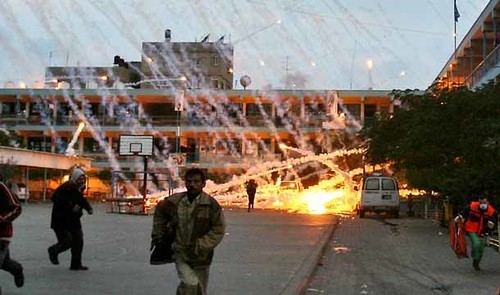
    First off, the account of the shelling of the United Nations Relief and Works Agency (UNRWA) compound in the southern Rimal area of Gaza City, on January 15th of this year. It's interesting reading. You find it on page 162 to 174 of the PDF.


    (photo by Flickr user blhphotography CC-BY)

    Basically what happened here was that the Israeli forces, despite having GPS coordinates and despite at least forty telephone calls from UN leaders in Gaza and Palestine to Israeli authorities through established channels on that morning and provable contact between those authorities and the field personnel of the army, they repeatedly shelled a United Nations compound where 700 Palestinians were taking refuge, with illegal white phosphorous grenades.

    The report is blistering in its dismantling of the Israeli arguments defending this attack, summed up in this paragraph:
    The question then becomes how specialists expertly trained in the complex issue of artillery deployment and aware of the presence of an extremely sensitive site can strike that site ten times while apparently trying to avoid it.
    They also note that the area struck by the shells was within one football pitch of one another, and coincidentally, the incendiary weapons all happened to strike near the enormous fuel depot of several hundred thousand litres of fuel on the site. The entire site was two football pitches in size.


    Another paragraph that struck me deals with the equally horrific attack on the Al-Quds hospital, in direct violation of Geneva Convention IV §18 and §19. The Israeli military also used illegal white phosphorous shells here. The story that really struck me was this one:
    596. The doctors with whom the Mission spoke all occupied senior positions but also witnessed the events that occurred throughout that day. The Mission was impressed with their objectivity and the genuine distress several of them showed at being unable to help or protect the sick and wounded who had come to the hospital. Throughout that day many of the staff, including the doctors, took exceptional risks to stop fire spreading, including by removing white phosphorous wedges from near diesel tanks. One doctor in particular showed remarkable courage. He left the hospital to drive an ambulance through artillery shelling as he sought to bring an eight-year-old girl to al-Shifa hospital for treatment which he was no longer able to provide in al-Quds. Having taken the girl there, he drove back to the hospital in the same conditions to continue assisting the efforts to fight the fires.
    The 8 year-old girl, who had been shot in the jaw by an Israeli sniper (since the snipers prepare their shots, presumably while she was engaged in launching terror rockets against Israeli settlements or other military activities), later died from her injuries. The report concludes that she would not have died had the attack on the hospital not occurred and considers the Israeli military responsible for her death.

    *


    Longtime readers of this blog have probably noticed that I will occasionally write about human rights, international humanitarian law, crimes of war or crimes against humanity, which are all topics I've been interested in since at least high school. For two years in high school and on and off afterwards I was an active member of my school Amnesty Youth group. It was a great time, and I learned most of what I know about international law and human rights -- which isn't a lot compared to most of the wonderful activists I met in Amnesty -- during those two years. Then, just as I was starting university and entering my last time in Amnesty, I bought a book called Crimes of War: What the Public Should Know. I think more people should do themselves the favour of reading that book. It is by far the best introduction to the topic I know of.

    If I'm completely honest, I pretty much bought it impulsively because it's an uncannily well-designed, physically beautiful book: it is printed on high-quality smooth paper and bound in a strange, tall and narrow format, with a gorgeously simplistic cover and a magazine-like layout. It is thoroughly illustrated with stunning black and white photographs from war zones all over the world taken by some of our time's leading photojournalists, including many from the Magnum group.

    But the book turned out to be a remarkable book which I am constantly coming back to. It is basically an illustrated A to Z guide to war crimes and international humanitarian law written by legal scholars and other experts. I know that sounds dry, but it is quite simply relentlessly readable. I read it from cover to cover (it is ingeniously laid out so that if you read it in this order, it proceeds more or less from basic rules to more complex issues). It is meant as a guide for people requiring a basic working knowledge of the laws of war. In this day and age, I'm afraid that means everyone who follows the news, but particularly journalists, commentators, teachers, activists, aid workers, anyone working with international issues and politicians.

    I still find myself constantly returning to this book to look things up -- if my brother hasn't stolen it, that is -- and refind my footing when Israel or the US or some other beligerent power tries to relativise what they have done or try to give rhetorical cover to their crimes. It is one of the most useful books I have ever read, and while I have read many other books later on these topics, this one must be the most influential one. I have made a habit of recommending it to everyone over the past couple of years.

    So imagine my delight when I discovered yesterday that the entire book has been made availably online for free along with numerous other extra materials, commentary and articles not in the book.

    Though you will have to miss out on the great layout on the web, I hope that at least a few of my literally tens of readers will take the time out to read a few articles or maybe even the whole thing over a few days. It's a book that taught me a lot proportional to the amount of work I had to put into it. I can only second the blurb on the back, from W. Pfaff of the International Herald Tribune: "A reference work that has no counterpart ... civilization is in debt to all [its contributors]."

    Labels: , , , , ,

    26.10.09

    What came first? The chicken — or Protocol I Additional to the Geneva Conventions of 12 August 1949?


    Commenter Alex thinks my concern about the killing of chickens belonging to Palestinian civilians during the bombing of Gaza doesn't really capture the gravitas of the Gaza situation:
    with all do respect to the atrocity of killing 31,000 chickens: it is horrible and unmoral but it is not a humanitarian crime or a crime against humanity. We can protest, but we can't trial people for that
    And since I think this might be a common misconception, I did some legwork and dug up the relevant legal points for you, gentle reader.

    You might not think that killing chickens could be a crime against humanity, but it can be, and in this case, it is.

    What follows is my reply to Alex, lightly edited for clarity:

    As to your last point I must disagree in the strongest possible terms. International Humanitarian Law is crystal clear on this matter. The demolition of the chicken farm was completely and obviously illegal. It was a war crime, and quite possibly a crime against humanity.

    The first and most clear violation is of article 52 of Additional Protocol I to the Geneva Conventions, ratified in 1977. Which, notably, Israel has not ratified. However, it is now accepted throughout the world as being customary international law, and the IDF is completely bound by it.

    Art. 52 of Protocol I states that
    1. Civilian objects shall not be the object of attack or of reprisals. Civilian objects are all objects which are not military objectives as defined in paragraph

    2. Attacks shall be limited strictly to military objectives. In so far as objects are concerned, military objectives are limited to those objects which by their nature, location, purpose or use make an effective contribution to military action and whose total or partial destruction, capture or neutralization, in the circumstances ruling at the time, offers a definite military advantage.

    3. In case of doubt whether an object which is normally dedicated to civilian purposes, such as a place of worship, a house or other dwelling or a school, is being used to make an effective contribution to military action, it shall be presumed not to be so used.
    I don't seem to remember chickens having military applications, unless of course the Palestinians have somehow gotten hold of a "Blue Peacock" nuclear device. And foodstuffs that are also (indeed, primarily) used for civilian populations are not legitimate targets.

    Secondly, this is also a blatant violation of article 55 of the fourth Geneva Convention, ratified in 1949, and which Israel HAS ratified. Article 55 states that:
    To the fullest extent of the means available to it, the Occupying Power has the duty of ensuring the food and medical supplies of the population; it should, in particular, bring in the necessary foodstuffs, medical stores and other articles if the resources of the occupied territory are inadequate.

    The Occupying Power may not requisition foodstuffs, articles or medical supplies available in the occupied territory, except for use by the occupation forces and administration personnel, and then only if the requirements of the civilian population have been taken into account. Subject to the provisions of other international Conventions, the Occupying Power shall make arrangements to ensure that fair value is paid for any requisitioned goods.

    The Protecting Power shall, at any time, be at liberty to verify the state of the food and medical supplies in occupied territories, except where temporary restrictions are made necessary by imperative military requirements.
    In case you were wondering, "imperative military requirements" does not include "because we've blocaded Gaza again", "because we're busy bombing the civilian population" or "because we felt like it".


    The definition of "crimes against humanity" contained in the Rome Statute of the ICC is basically really bad things – including war crimes – being done in a systematic way. A system of oppression which derives a people of basic neccesities easily falls under this heading. The destruction of the chicken coops may have been tougher on the chickens than the people in the area. But it was also beyond a shadow of a doubt a crime of war and almost certainly part of a system of abuse which constitutes a crime against humanity.


    *

    (all photos by Flickr user Rafahkid, CC-BY-SA. The photos do not display the destruction of this particular chicken farm, but of another destruction of a chicken farm. You could almost think they were targeting chicken farms intentionally! Rafahkid has more photos of this incident in his photostream.)

    Labels: , , , , ,

    24.10.09

    Israel's chickens coming home to roost

    I'm reading the Goldstone Report (warning: relatively big PDF) a 600-page document that details the findings of a panel investigating the attack on Gaza last winter. It's an astounding document. Not only is it an interesting and immensely readable introduction to the contemporary situation in the Israeli-Palestinian conflict and the oppression of the Palestine people, it is also simply an exquisitely convincing argument. Meticulous, detailed and balanced. It is the objective document that critics on both sides have argued for. It doesn't hesitate to show the full force of Palestinian in-fighting and unlawful attacks on Israel by mortar and Qassam rockets, but it also does not hesitate to shove Israel's face in what they've done. And they have done so very, very much.

    It details and substantiates the allegations of deliberate attacks on civilians. I mean, some people might have gotten the impression that those allegations came from crazy, Kalashnikov-toting jihadists. No, those allegations came from so many credible sources that they can no longer be denied. The Goldstone Report documents a pattern of systematic attack on a defenceless civilian population. The Israeli army committed crimes against humanity, and war crimes. The people responsible need to lose their jobs, then they have to be tried and convicted and spend the rest of their lives in prison.

    I've read a few documents like The Goldstone report when I was a member of Amnesty and a couple of times afterwards, as well. There is always some detail that gets you. Some ridiculous little piece of information or a telling story that is the convincing detail in the argument being made. It might be the story of how a political activist was shot in front of his children in Chile or the story of how the police routinely administered beatings to 12-years in the US. In the Goldstone Report, for me, it was the chickens:
    The chicken farms of Mr. Sameh Sawafeary in the Zeitoun neighbourhood south of Gaza City reportedly supplied over 10 per cent of the Gaza egg market. Armoured bulldozers of the Israeli forces systematically flattened the chicken coops, killing all 31,000 chickens inside, and destroyed the plant and material necessary for the business. The Mission concludes that this was a deliberate act of wanton destruction not justified by any military necessity and draws the same legal conclusions as in the case of [a similar destruction of a flour mill a few days before].
    For some reason the image of Israeli soldiers bringing the roof down on 31.000 chickens, for no good military reason other than just to fuck with the civilian population of Gaza; for spite, out of malice, is the detail that really got me.

    The Goldstone Report is, in short, mandatory reading for anyone looking for an understanding of the contemporary situation in Gaza and Israel/Palestine. It is readable, well-documented and convincing. As Klassekampen's reviewer Espen Stueland said of another recently published book on Gaza, I know of no words of greater significance that could be read right now.

    (Norwegians will find that Mads Gilbert and Erik Fosse's book Øyne i Gaza (Gyldendal, 2009) makes a wonderful supplement to the report.)

    Labels: , , , , , , , , ,

    19.4.09

    torture & other things I'm reading about

    Obama won't prosecute the torturers. This "stands Nuremberg on its head" according to Mike Farrell, President of the board of Death Penalty Focus and Co-Chair Emeritus of the Southern California Committee of Human Rights Watch.

    The Nuremberg defense, as you know, Bob, is basically when people say that "I was just following orders when I committed this war crime. How was I to know slaughtering jews or simulating drowning was wrong? I mean: it's war, who am i to know that mass murder or torture is a bad thing? It's not like our society has a strict code of morality about these things or anything. Right? Right?"

    Well, nuts to you, my good man! says the Nuremberg principles:

    The fact that a person acted pursuant to order of his Government or of a superior does not relieve him from responsibility under international law, provided a moral choice was in fact possible to him.

    *

    What kind of torture, you ask? Well, Khalid Sheikh Mohammed experienced simulated execution by drowning (waterboarding) more than 6 times a day for a month, a total of 183 times in 30 days.

    *


    Bernhard Ellefsen was kind enough to make me aware of two articles by Mark Danner on the torture reports etc. I haven't looked at them yet, but from the skimming, they look really good:

    "US Torture: Voices from the Black Sites" and "The Red Cross Torture Report: What It Means".

    Ellefsen has a video of Danner on CNN up right now at the link above.

    *


    Here are the actual torture memos by the Bush administration, recently released by the Obama administration, explaining in deliberate, crimes-against-humanity-conviction-inducing prose how to torture a person in such away that it somehow fails to be torture:

    In addition to using the cont1ncment boxes alone, you would like to introduce an insect into one of the boxes with Zubaydah. As we understand it, you plan to inform Zubaydah that you are going to place a stinging insect into the box, but you will actually place a harmless insect in the box, such as a caterpillar. If you do so, to ensure that you are outside the predicate act requirement, you must inform him that the insects "will not have a sting that would produce death or severe pain. If, however, you were to place the insect in the box without informing him that you're doing so,then in order to commit a predicate act, you should not affirmatively lead him to believe that any insects... the approaches we have described, the insect's placement in the box should not constitute a threat of severe physical pain or suffering to a reasonable person in his position. An individual placed in a box, even an individual with a fear of insects, would not reasonably feel threatened with severe physical pain or suffering if a caterpillar was placed in the box. Further, you have informed us that you are not aware that Zubaydah has any allergies to insects, and you have not informed us of any other factors that would cause a reasonable person in that same situation to
    believe that an ... cause him severe physical pain or death. Thus, we
    conclude that the placement of the insect in the confinement box...
    blah blah blah. Basically, Bybee is arguing that if you shut someone into a coffin-sized box WITH AN INSECT walking all over him, even if he had a phobia for insects, then that is somehow not torture. He could be in the box for hours at a time. With the insect. I have no such phobia, and I don't think I would remain sane if someone did this to me. These documents are worth reading. Pure, distilled banality of evil. 

    *


    Last but not least on torture, an editorial in the NY Times in which they finally, finally, fucking finally bring out the big guns against the Bush administration:

    At least Mr. Obama is not following Mr. Bush’s example of showy trials for the small fry — like Lynndie England of Abu Ghraib notoriety. But he has an obligation to pursue what is clear evidence of a government policy sanctioning the torture and abuse of prisoners — in violation of international law and the Constitution.

    That investigation should start with the lawyers who wrote these sickening memos, including John Yoo, who now teaches law in California; Steven Bradbury, who was job-hunting when we last heard; and Mr. Bybee, who holds the lifetime seat on the federal appeals court that Mr. Bush rewarded him with.

    These memos make it clear that Mr. Bybee is unfit for a job that requires legal judgment and a respect for the Constitution. Congress should impeach him. And if the administration will not conduct a thorough investigation of these issues, then Congress has a constitutional duty to hold the executive branch accountable. If that means putting Donald Rumsfeld and Alberto Gonzales on the stand, even Dick Cheney, we are sure Americans can handle it.

    After eight years without transparency or accountability, Mr. Obama promised the American people both. His decision to release these memos was another sign of his commitment to transparency. We are waiting to see an equal commitment to accountability. [my italics]


    *


    further torture update:

    Digby, as usual making lots of sense. Read the Danner articles. They're good.


    *


    On the other hand, when Obama is not letting torturers go free, he is starting high-speed rail projects across the US. That is awesome. Now if only the Norwegian Arbeiderpartiet could get its ass in gear on this issue at their meeting this weekend, we could get something done in the next ten years.

    *


    Speaking of which, here's our prime minister saying that Twitter and Facebook are important (Norwegian). The left parties are finally starting to realise what a tool for change the web can be when they take the lead. I tried telling them this five years ago, but would they listen? No.

    *


    Ezra Klein on why the US health care system costs so much. Part I, part II.

    *


    Ian McEwan on John Updike. I never liked Updike. He could bang a sentence together like nobody's business but his books, the few that I have had to read, have always felt morally flawed and self-centered to me. But it's always interesting to see what others saw in him.

    Labels: , , , , , , , , , , ,

    19.1.09

    Number crunching

    According to the Al-Jazeera Gaza Twitterbot, Hamas is reporting that 48 of its fighters were killed in the Gaza bombings and the subsequent invasion. 

    According to Gaza Body Count, 1203 dead have been confirmed so far. Those 1203 are 98,93 % of the casualties, with the remaining 1.07 % - 13 dead - on the Israeli side. 

    If that's true, then 3.99 %, almost 4 % of those killed on the Palestinian side were legitimate targets. The remaining 96 % were innocent bystanders. 

    Or, well, "bystanders" is maybe the wrong word, seeing as how they were locked inside a territory they couldn't escape from. Maybe "terror victims" or "murder victims" are a better phrase.

    Whatever we call them, I believe that percentage is far higher than most wars in the 20th century. I have top people getting the numbers now. In the meantime, let's suffice to say that there is no way that this can be adequately described as a war on Hamas aggression. Reading purely from the numbers, this was a war on Palestinian civilians which happened to hit some Hamas fighters. I'm sure you could pretty much carpet bomb Gaza and get the same percentage. I wonder if they were even aiming. 

    Update: My top people. Well... Mikkel, actually, has gotten hold of the numbers. They're in comments.

    Labels: , , , , , , ,

    5.1.09

    Highly civilised people

    Every morning's newsletter from the New York Times contains a note at the bottom about events that took place on this day in history. On December 29th, the third day of the Gaza bombing campaign, it read "On Dec. 29, 1940, during World War II, Germany began dropping incendiary bombs on London." For the people of London, if they had time to reflect on the irony, this must have seemed like the perversion of New Years Eve. Fireworks raining down in destruction, rather than celebration. "As I write", wrote George Orwell in an article published two months after the firebombing started, "highly civilized human beings are flying overhead, trying to kill me."

    George Orwell


    As of yesterday, at least 437 people have died in Gaza and 2,250 have been injured by highly civilised human beings since Israel's bombing campaign began. Many of them were civilians. Women. Children. 1.5 million people live on the Gaza strip, and half of them are under 14. It is the most densely populated area in the world, and all the doors are locked. How do you think the people there are feeling?


    Let's not use names that do not fit the reality of events. The bombing of Gaza is a crime against humanity and a mass murder of civilians. There is nothing proportional or proper about this. There is nothing here that conforms to the laws of war. The people who ordered it are war criminals who should be tried in the International Criminal Court and spend the rest of their natural lives in jail.

    On December 29th, I participated in a protest that drew several hundred people out against the bombings. We started at Parliament and then moved up the hill to the area outside the Israeli embassy. The mood was aggressive and unpleasant, dominated by Palestinian and other Arab teenagers and young men. Several people, mainly male refugees in their 40s, as far as I could tell, were waving signs saying "[Star of David] = [Swastika]". As we ascended the hill next to the royal palace, I saw young men running off into flowerbeds to pick up rocks. As we neared the embassy, I had already realised that things were going to go wrong, and I decided to make myself scarce. I detached myself from the protest, cut through the park, came out 50 meters in front of the column of people and passed just in front of the police barricade before making my way out of the protester's paths.

    As the protesters reached the barricades, I saw rocks flying and fireworks arcing out and exploding under the streetlamps. I watched the protest for a little while, until I got too cold, and then skulked off home. On the evening news, I saw that the conflict had escalated and the police had used tear gas, and we saw kids in Palestinian headscarves lighting things on fire and overturning barricades and being driven away by police.

    And so, another chance of creating the image of a respectable peace movement was wasted. In the minds of television viewers across the country, supporting the cause of solidarity with the oppressed Palestinian people is something that angry kids with masks across their face and rocks in their hands do.

    Am I angry with the kids who threw rocks? Of course I am. What they did was wrong and counterproductive. Do I understand why they feel the way they feel? Of course I do. I feel much the same way. But I'm using that feeling differently.

    Protests, though not neccessarily the most effective form of political action, are acts of political speech. They are meant to cause action to be taken. They are meant to change minds, to articulate grievances and differences, to show disgust and to be humane in the face of barbarism. They are rhetorical acts. Rhetoric is language which is instrumental: it is measured by how much it gets things done.

    Throwing rocks accomplishes nothing. It creates a quick fix of gratification, an outlet for rage. Then the tear gas clears and nothing has changed. We aren't in this for our own gratification. We are in this to create political solidarity with the suffering people of Gaza. We want to end the violence and the oppression. More violence does not help. We are trying to build and articulate political consensus that will force the Israeli to end the violence in Gaza, and the unlawful occupation and oppression of the Palestine people.


    Said more generally, though, I think that the actions of the protesters are going against the grain of what the peace movement has to be. It has to do with how I see what we're up against. Consider for a moment what the term "crimes against humanity" mean. According to the Rome Charter, it means:
    [P]articularly odious offences in that they constitute a serious attack on human dignity or grave humiliation or a degradation of one or more human beings. They are not isolated or sporadic events, but are part either of a government policy (although the perpetrators need not identify themselves with this policy) or of a wide practice of atrocities tolerated or condoned by a government or a de facto authority. However, murder, extermination, torture, rape, political, racial, or religious persecution and other inhumane acts reach the threshold of crimes against humanity only if they are part of a widespread or systematic practice. Isolated inhumane acts of this nature may constitute grave infringements of human rights, or depending on the circumstances, war crimes, but may fall short of falling into the category of crimes under discussion [emphasis mine]
    That the bombing campaign on Gaza is a war crime is so obvious one must be criminally negligent to think otherwise. That it also constitutes a crime against humanity is now something that we, as activists, must keep in constant focus. The people directing this atrocity should never set foot outside of Israel again unless it is to see the inside of the International Criminal Court.

    When I began this post with the note on the incendiary bombing of London, I was drawing an obvious paralell. But the paralell does not appear to be as obvious to everyone as it should be (think, for instance, of the banners I saw in the protest. The idea that this has anything to do with Jewishness is stupid and must be beaten back at all costs. Norwegians can think, for instance, of Trond Andresen's unbelievably stupid article in this Saturday's Klassekampen). So to clarify: my point is that the Israeli government and military are, like the highly civilisaed beings of Orwell's time, comitting crimes against humanity from the air. Raining fire and brimstone on the innocent and the guilty alike. Burning children alive. Killing pregnant women. Killing people who had nothing to do with anything; who were just living their lives. Highly civilised people.

    Consider again what crimes against humanity means. It isn't just blowing children up and saying that there is no crisis here. It is doing so as part of a systematic policy of atrocity. The children die because there is a plan in which their lives are not valued. A crime against humanity is using the power of the human intellect and rationality to destroy the civilisation which raised it. It is a crime which destroys our very humanity by using our humanity against ourselves. It is the perversion of thought.

    The bombings are a nightmare, but it a nightmare of human invention - a crime against humanity. Crimes have perpetrators. Perpetrators can be tried and they can be punished. Don't throw rocks. All rocks that we throw hit ourselves. We will get through this by being calm but full of rage. Keep the rage alive and use it productively.

    The opposite of a crime against humanity is civilisation. It is to use the same highly civilised gifts and powers and institutions that the crimes against humanity pervert in order to create peace, security and freedom.

    I want people to talk about what is happening. Write about it, protest about it, demand action from your government, not just words. Demans Security Council intervention. Demand a peacekeeping force. Demans a boycott (if you think that will help - I'm unconvinced). But: Spread the information around. Sooner or later, something has to give. But for that to happen the peace movement has to be serious, it has to be massive, it has to be across the entire cross-section of humanity and most of all, it has got to be peaceful. We have to channel our rage through civilisation, not out of it, or towards it. We have to be even more highly civilised than our barbaric adversaries.

    It sticks with me that the kids at the protest were throwing fireworks. I think this had to with available weapons at the time (later, they supposedly tried siphoning gas from nearby cars). Their rage was greater than the weapons available, but even with better weapons, they couldn't have won the war. It struck me, then, that this is a metaphor for what I am trying to argue here. We win when we stop trying to do the same as our opponents with weaker weapons. That's what being civilised is all about. Fireworks should be the highly civilised opposite of a barbarically civilised aerial bombardment, not an impotent attempt to replicate that bombardment on the ground. So save the fireworks people, please. We'll have plenty of use for them when we win.

    Labels: , , , , , , ,

    4.1.09

    The situation in Gaza is "catastrophic"


    That's John Ging from the UN Relief and Works Agency speaking. "It really is difficult to convey in words..."

    Labels: , , , , ,

    SMS from Gaza

    Mads Gilbert is a Norwegian doctor and solidarity worker who is one of very few foreigners providing eyewitness accounts to Norwegian media from inside the Gaza strip, where he is volunteering at a hospital.

    This one was verified to me earlier today by people in the aid community in touch with Mads Gilbert as being geniune. I've snipped the translation from Shädy Äcres:

    "Thanks for your support.. They bombed the central vegetable market in Gaza city two hours ago. 80 injured, 20 killed. All came here to Shifa. Hades! We wade in death. Blood and amputees. Many children. Pregnant woman. I have never experienced anything this terrible. Now hearing tanks. Tell it, pass it on, shout it. Anything. DO SOMETHING! DO MORE! We're living in the history books now, all of us! Mads G, 3.1.09 13:50, Gaza, Palestine.
    How dare they say there is not a humanitarian disaster happening? This is a crime against humanity. The leaders of this atrocity should be tried and convicted and thrown in jail for the rest of their lives.

    Labels: , , , , , , , , ,

    Livni lyger

    Klassekampen har et veldig bra intervju i sin lørdagsutgave med Mads Gilbert, en norsk lege og Palestina-aktivist som driver med nødhjelp i Gaza. Det er verdt å lese, om ikke annet så for å bryte med de barbariske uttalelsene til Tzipi Livni til Haaretz:

    Livni said "there is no humanitarian crisis in the Strip, and therefore there is no need for a humanitarian truce."

    In her remarks to reporters, Livni said Israel had been careful to protect the civilian population and had kept the humanitarian situation in Gaza "completely as it should be".
    Kontraster denne åpenbare løgnen med Gilberts situasjonsbeskrivelse:

    Gilbert er sjokkert over uttalelser fra Israels utenriksminister Tzipi Livni om at det ikke er noen humanitær krise i Gaza.

    - Det er tydelig at Livni ikke har sett de som vi ser. Det som foregår i Gaza, er en menneskeskapt humanitær katastrofe. Halvannen million mennesker er sperret inne på et lite område, uten fluktmuligheter. De er nesten uten inntekter, strøm, mat og medisiner, og har ingen beskyttelse. For første gang på våre reiser i området, har Erik og jeg sett folk i matkøer. Dette er det nærmeste vi kommer Warszawa-gettoen. Når Israels regjering sier at dette ikke er en humanitær krise, er deres historiske hukommelse særdeles kort.

    - Israel hevder at Hamas hindrer distribusjon av humanitære hjelpesendinger?

    - Dette stemmer etter det vi får vite overhodet ikke. Israel sprer nå så mange løgner om konflikten og forholdene i Gaza at det nesten ikke er til å tro. Problemet her er ikke Hamas, men den israelske okkupasjonen og en lammende blokade, som blant annet har tvunget helsevesenet i kne også før de siste, dramatiske krigshandlingene. Blant de mindre synlige konsekvensene er at behandlingstilbudet for vanlige sykdommer og skader i en utsatt befolkning på halvannen million, praktisk talt er lik null.

    100 mot en


    - Jens Stoltenberg gikk i sin nyttårstale langt i å sidestille Hamas’ raketter og Israels flyangrep, og dette preger mange vestlige reaksjoner. Hvordan oppfattes dette i Gaza?

    - Det er fullstendig absurd å framstille dette som en symmetrisk konflikt med delt ansvar. Det er en vanlig oppfatning blant lokalpolitikere og andre i Gaza om at disse nålestikkangrepene mot Israel bør innstilles, men det er ute av alle proporsjoner å sammenlikne dette med Israels militæraksjon. Til nå er tre israelere drept, og mer enn 400 palestinere. Det går altså mer enn 100 palestinske liv på ett israelsk. Vi vet av rik erfaring at alle palestinske ledere blir behandlet som terrorister av israelerne. Dette skjedde også da tusenvis av sivile ble drept i Israels kamp mot PLO og Yassir Arafat på åttitallet.

    Labels: , , , , ,