*

TWITTER | @martingruner

    8.6.09

    Why I Read

    I dreamt I dwelt in marble halls,
    And woke to find it true;
    I wasn't born for an age like this;
    Was Smith? Was Jones? Were you?
    (George Orwell, "Why I Write")
    The fact that he was writing this in 1935 in rhyme should maybe have tipped him off he wasn't made for an age like this.

    Anyway, found professional occasion to go back to this essay by Orwell this morning. Read all about it in a month or three.

    Labels: , ,

    5.1.09

    Highly civilised people

    Every morning's newsletter from the New York Times contains a note at the bottom about events that took place on this day in history. On December 29th, the third day of the Gaza bombing campaign, it read "On Dec. 29, 1940, during World War II, Germany began dropping incendiary bombs on London." For the people of London, if they had time to reflect on the irony, this must have seemed like the perversion of New Years Eve. Fireworks raining down in destruction, rather than celebration. "As I write", wrote George Orwell in an article published two months after the firebombing started, "highly civilized human beings are flying overhead, trying to kill me."

    George Orwell


    As of yesterday, at least 437 people have died in Gaza and 2,250 have been injured by highly civilised human beings since Israel's bombing campaign began. Many of them were civilians. Women. Children. 1.5 million people live on the Gaza strip, and half of them are under 14. It is the most densely populated area in the world, and all the doors are locked. How do you think the people there are feeling?


    Let's not use names that do not fit the reality of events. The bombing of Gaza is a crime against humanity and a mass murder of civilians. There is nothing proportional or proper about this. There is nothing here that conforms to the laws of war. The people who ordered it are war criminals who should be tried in the International Criminal Court and spend the rest of their natural lives in jail.

    On December 29th, I participated in a protest that drew several hundred people out against the bombings. We started at Parliament and then moved up the hill to the area outside the Israeli embassy. The mood was aggressive and unpleasant, dominated by Palestinian and other Arab teenagers and young men. Several people, mainly male refugees in their 40s, as far as I could tell, were waving signs saying "[Star of David] = [Swastika]". As we ascended the hill next to the royal palace, I saw young men running off into flowerbeds to pick up rocks. As we neared the embassy, I had already realised that things were going to go wrong, and I decided to make myself scarce. I detached myself from the protest, cut through the park, came out 50 meters in front of the column of people and passed just in front of the police barricade before making my way out of the protester's paths.

    As the protesters reached the barricades, I saw rocks flying and fireworks arcing out and exploding under the streetlamps. I watched the protest for a little while, until I got too cold, and then skulked off home. On the evening news, I saw that the conflict had escalated and the police had used tear gas, and we saw kids in Palestinian headscarves lighting things on fire and overturning barricades and being driven away by police.

    And so, another chance of creating the image of a respectable peace movement was wasted. In the minds of television viewers across the country, supporting the cause of solidarity with the oppressed Palestinian people is something that angry kids with masks across their face and rocks in their hands do.

    Am I angry with the kids who threw rocks? Of course I am. What they did was wrong and counterproductive. Do I understand why they feel the way they feel? Of course I do. I feel much the same way. But I'm using that feeling differently.

    Protests, though not neccessarily the most effective form of political action, are acts of political speech. They are meant to cause action to be taken. They are meant to change minds, to articulate grievances and differences, to show disgust and to be humane in the face of barbarism. They are rhetorical acts. Rhetoric is language which is instrumental: it is measured by how much it gets things done.

    Throwing rocks accomplishes nothing. It creates a quick fix of gratification, an outlet for rage. Then the tear gas clears and nothing has changed. We aren't in this for our own gratification. We are in this to create political solidarity with the suffering people of Gaza. We want to end the violence and the oppression. More violence does not help. We are trying to build and articulate political consensus that will force the Israeli to end the violence in Gaza, and the unlawful occupation and oppression of the Palestine people.


    Said more generally, though, I think that the actions of the protesters are going against the grain of what the peace movement has to be. It has to do with how I see what we're up against. Consider for a moment what the term "crimes against humanity" mean. According to the Rome Charter, it means:
    [P]articularly odious offences in that they constitute a serious attack on human dignity or grave humiliation or a degradation of one or more human beings. They are not isolated or sporadic events, but are part either of a government policy (although the perpetrators need not identify themselves with this policy) or of a wide practice of atrocities tolerated or condoned by a government or a de facto authority. However, murder, extermination, torture, rape, political, racial, or religious persecution and other inhumane acts reach the threshold of crimes against humanity only if they are part of a widespread or systematic practice. Isolated inhumane acts of this nature may constitute grave infringements of human rights, or depending on the circumstances, war crimes, but may fall short of falling into the category of crimes under discussion [emphasis mine]
    That the bombing campaign on Gaza is a war crime is so obvious one must be criminally negligent to think otherwise. That it also constitutes a crime against humanity is now something that we, as activists, must keep in constant focus. The people directing this atrocity should never set foot outside of Israel again unless it is to see the inside of the International Criminal Court.

    When I began this post with the note on the incendiary bombing of London, I was drawing an obvious paralell. But the paralell does not appear to be as obvious to everyone as it should be (think, for instance, of the banners I saw in the protest. The idea that this has anything to do with Jewishness is stupid and must be beaten back at all costs. Norwegians can think, for instance, of Trond Andresen's unbelievably stupid article in this Saturday's Klassekampen). So to clarify: my point is that the Israeli government and military are, like the highly civilisaed beings of Orwell's time, comitting crimes against humanity from the air. Raining fire and brimstone on the innocent and the guilty alike. Burning children alive. Killing pregnant women. Killing people who had nothing to do with anything; who were just living their lives. Highly civilised people.

    Consider again what crimes against humanity means. It isn't just blowing children up and saying that there is no crisis here. It is doing so as part of a systematic policy of atrocity. The children die because there is a plan in which their lives are not valued. A crime against humanity is using the power of the human intellect and rationality to destroy the civilisation which raised it. It is a crime which destroys our very humanity by using our humanity against ourselves. It is the perversion of thought.

    The bombings are a nightmare, but it a nightmare of human invention - a crime against humanity. Crimes have perpetrators. Perpetrators can be tried and they can be punished. Don't throw rocks. All rocks that we throw hit ourselves. We will get through this by being calm but full of rage. Keep the rage alive and use it productively.

    The opposite of a crime against humanity is civilisation. It is to use the same highly civilised gifts and powers and institutions that the crimes against humanity pervert in order to create peace, security and freedom.

    I want people to talk about what is happening. Write about it, protest about it, demand action from your government, not just words. Demans Security Council intervention. Demand a peacekeeping force. Demans a boycott (if you think that will help - I'm unconvinced). But: Spread the information around. Sooner or later, something has to give. But for that to happen the peace movement has to be serious, it has to be massive, it has to be across the entire cross-section of humanity and most of all, it has got to be peaceful. We have to channel our rage through civilisation, not out of it, or towards it. We have to be even more highly civilised than our barbaric adversaries.

    It sticks with me that the kids at the protest were throwing fireworks. I think this had to with available weapons at the time (later, they supposedly tried siphoning gas from nearby cars). Their rage was greater than the weapons available, but even with better weapons, they couldn't have won the war. It struck me, then, that this is a metaphor for what I am trying to argue here. We win when we stop trying to do the same as our opponents with weaker weapons. That's what being civilised is all about. Fireworks should be the highly civilised opposite of a barbarically civilised aerial bombardment, not an impotent attempt to replicate that bombardment on the ground. So save the fireworks people, please. We'll have plenty of use for them when we win.

    Labels: , , , , , , ,

    27.5.08

    Framtiden er ikke hva den en gang var

    Dette er en sak som jeg hadde på trykk i Klassekampens bokmagasin på lørdag. Den så ganske fin ut på trykk, med utrolig fin omslagsillustrasjon av Malvin, og portrettfoto av meg tatt av Tom Henning Bratlie (og Metropolis-still courtesy of avdøde Fritz Lang). Det glassaktige blikket mitt på bildet skyldes ikke at jeg hadde tatt for mye kokain, men snarere at jeg var helt kolossalt forkjølet når det ble tatt.
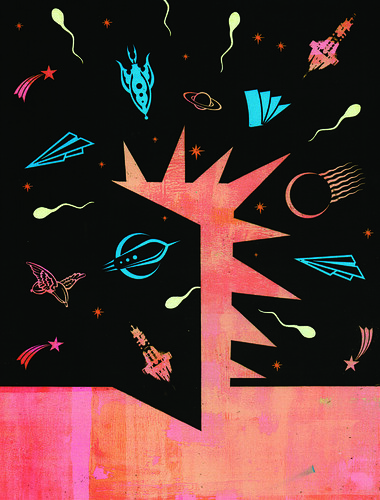

    illustrasjon: © M.M. Malvin, 2008.


    Framtiden er ikke hva den en gang var. Dagens framtidsskildrere pensjonerer utopien.

    av Martin Grüner Larsen

    [T]hey put Ming the Merciless in charge of designing California gas stations. (...) Lots of them featured superfluous central towers ringed with those strange radiator flanges that were a signature motif of the style and which made them look as though they might generate potent bursts of raw technological enthusiasm if you could only find the switch that turned them on.

    – William Gibson, «The Gernsback Continuum», 1981

    I novellen «The Gernsback Continuum» av William Gibson begynner en fotograf på 1980-tallet å hallusinere framtidsvisjoner fra 30-tallet som aldri ble noe av. Det blir fort klart for fotografen at det er ingenting som eldes raskere enn framtiden.

    Og det er få ting som utpeker seg så sterkt som fortidig som en tidsperiodes framtidsvisjoner, om det er 1800-tallets sosialistiske teknoutopisme, 1920-tallets futuristiske fartslinjer, «Metropolis»' skyline eller Gibsons egen cyberpunkbevegelse fra 80-tallet.

    Når Litteraturfestivalen på Lillehammer i år tar opp framtiden er det en anledning til å se nærmere på hvordan bøkene og tekstene vi omgir oss med former og skaper framtiden, og hvor man finner dagens framtid.

    En fast figur i diskusjonen om science fiction, fremtidslitteraturen framfor noen, har vært om den har evne til å forutsi framtiden. Sciencefictionforfatteren Tor Åge Bringsværd skal ha reunion med sin gamle partner Jon Bing på Lillehammer. Sammen er de innbegrepet av norsk science fiction. Bringsværd mener at spådomsideen er et blindspor i sciencefictionkritikk:

    – For meg er science fiction først og fremst samtidslitteratur. Det er å stille hypotetiske spørsmål: Hva er konsekvensene av at noe som skjer i vår tid, fortsetter? Hypotetiske spørsmål er de viktigste spørsmålene vi kan stille, og det er de spørsmålene politikere konsekvent aldri vil svare på. «Spekulasjoner», sier de.

    Men det er nettopp derfor science fiction er et av de beste redskapene vi har til å skrive politisk litteratur! Der har man muligheten til å ta disse viktige spørsmålene på alvor. Science fiction er nok den mest samfunnskritiske litteraturen jeg vet om, og jeg mener at det er symptomatisk at de fleste romaner som utgis i Norge i dag har flere traktorer enn PC-er i seg. Og når det er sagt så er det viktig å understreke at jeg ikke er så interessert i de tekniske landevinningene for sin egen skyld. Jeg er selvsagt opptatt av hva de gjør med oss.

    Profetier og dystopier

    Likevel er det jo alt for ofte slik at science fiction leses som forsøk på profetier?

    – Ja, og det er en alvorlig misforståelse. La meg gi et eksempel på det: George Orwell skrev romanen 1984 i 1948. Når vi så kom til året 1984 så var avisene fulle av overskrifter om det gikk som han hadde spådd, og spørsmål om vi levde i Orwells mareritt, og det gjorde vi jo altså ikke. Men poenget var jo at han ikke spådde. Han skrev om det han så rundt seg, med overvåking og totalitære regimer og propaganda. Det var en advarsel om hvor samfunnsutviklingen kunne ende opp, og for så vidt stadig kan ende opp. Man skriver en dystopi for å forhindre den, sier Bringsværd.

    Men hva er så science fictions rolle i forhold til sakprosa? Sakprosaen har tilsynelatende alltid, helt siden Platons Staten, skapt utopier og dystopier, framtidsvisjoner som vi styrer etter eller styrer unna. Bringsværd mener at sakprosaen og science fiction er to måter å gjøre det samme på:

    – De griper ofte inn i hverandre. Jeg tenker litt på dem som fettere og kusiner, men har alltid foretrukket å bruke fabelen heller enn sakprosa. Men av en eller annen grunn er sakprosa ansett som å ha mer tyngde eller virkelighet enn fiksjonen. Men det har den overhodet ikke. All fiksjon og all sakprosa er det samme: tolkninger av virkeligheten.

    Man skriver en dystopi for å forhindre den.
    Tor Åge Bringsværd


    Debattbokens gjenkomst

    Men her skiller Bringsværd klart lag med Norges eneste professor i sakprosa, Johan L. Tønnesson. Tønnesson insisterer på et klart skille mellom fiksjon og sakprosa, også når den produserer framtidsvisjoner. Men han mener de er like viktige:

    – Dette er et område der skjønnlitteratur og sakprosa må få leve side om side. Mye science fiction, vidt bestemt, har vært enormt viktig i å forme våre ideer om hvor vi er på vei, og det kommer det til å fortsette å være. Tenk bare på dystopiene i Aldous Huxleys Brave New World eller George Orwells 1984. De har jo vært styrende for vår samfunnsforståelse, også lenge etter at vi nådde 1984.

    Det er vanlig å tenke at skjønnlitteratur kan ha dette fremadskuende, store over seg. Det kan også stort tenkt sakprosa ha. Om jeg selv skal spå i framtida, så er det nok særlig debattboka som kommer til å få et nytt oppsving framover. Det er fordi vi har fått en intens debattkultur i veldig mange, og ikke minst veldig raske fora. Da er det godt for oss å gjenoppdage den styrken som ligger i de resonnementene som går over mange sider og har vært igjennom en redaksjonell prosess. Jeg tenker for eksempel på en bok som «Hva skjer i Nord-Norge» av Ottar Brox. Den er en utrolig viktig bok for min generasjon. En debattbok som til de grader var i samtiden, men pekte framover. Jeg tror den har hatt mye å si både for nordnorsk politikk og norsk politikk overhodet. Denne typen bøker kommer vi forhåpentligvis til å se flere av, sier Tønnesson.

    Oppsvinget han spår for debattboka henger sammen med en stigende trend for sakprosaen i hele det litterære landskapet – og, mener Tønnesson, det er en motreaksjon mot 90-tallet og generasjon X sin ironiske distanse.

    – Jeg tror at ironigenerasjonens tilnærming var lite konstruktiv, og at vi allerede nå ser en reaksjon i form av et nytt alvor. På 90-tallet var debattboken nærmest et komisk prosjekt, nå er det en langt større tyngde i den. Og det er kanskje banalt å si det, men mange, mange av de sakprosatekstene som vi omgås til daglig er jo instruksjonstekster. En kokebok – med mindre man leser den i badekaret som nytelsesmiddel, det er det jo mange som gjør – har jo dette i seg at den skal munne ut i og bestemme framtidens matretter, ikke sant? Det er instruksjoner.

    – Så Marx og Engels' «Det kommunistiske manifest» er også en slags instruksjonsmanual?

    – Ja, absolutt! Den har dette framtidige i seg. Den er en instruksjonsmanual å forandre samfunnet. En kokebok for en bedre verden!

    Scenarier og spådommer

    Men hvordan skal man unngå rigide utopier eller «The Gernsback Continuum»s platte og ulevelige futurisme? For Tønnesson er det særlig scenariometoden som skiller seg ut som produktiv innen sakprosa:

    – Den utopiske eller dystopiske scenariemetoden har noen tiår på baken etter hvert. Den blomstret særlig opp tidlig på 80-tallet. I mange fagområder prøver man å forstå framtiden ved å sette opp modeller, og det er det man gjør når man skaper scenarier. I Norge hadde du et eksempel på dette i «Scenario 2000»-boka, redigert av Andreas Hompland. Den satte opp en rekke forskjellige scenarier for år 2000, og var viktig for alle politisk interesserte.

    Det morsomme med den boka er at ingen av scenariene slo til som spådom, men den utfylte likevel sin funksjon som anvisninger, sier Tønneson.

    – I tråd med min preferanse for det flerstemmige så mener jeg at scenariemetoden der man skaper flere alternativer er en bedre metode enn den klassiske utopien. Utopisme er en farlig og ofte totalitær måte å skrive framtid på, det har vi sett gang på gang i den historiske marxismen. Når utopisme tar overhånd, så forsvinner veldig mye av det etiske korrektivet.

    Ferdig med utopismen


    Audun Lysbakken er i framtidsbransjen. Nestlederen i Sosialistisk venstreparti (SV) har som oppgave å sette framtidsvisjoner ut i handling som politisk virkelighet. Han er for tiden på leting etter en ny framtid. Han har nettopp gjennomført Verden til venstre-konferansen. Prosjektet Verden til venstre, en ideologidebatt som skal føre fram mot et nytt arbeidsprogram for SV i 2009, durer videre. Lysbakken har flere ganger ytret ønske om at debatten skal føre fram til et nytt mål for venstresiden; noe å sikte etter. Klassekampen snakket med ham på telefon fra Bergensbanen.

    – Skal Verden til venstre bygge nye utopier for venstresiden?

    – Jeg vil kanskje ikke si utopier, men visjoner. Det er kanskje et definisjonsspørsmål, men jeg vil i alle fall skille mellom dem. På venstresiden betyr utopier alt for ofte at man har et ferdig framtidssamfunn på tegnebrettet, man blir opptatt av å realisere det så likt tegningen som mulig. Det har vi sett blir til en alt for dogmatisk oppfatning. Visjoner handler om å se at vi på den ene siden trenger bevissthet om hva som er mål for de politiske kampene vi står oppe i, slik at vi ikke bare forsoner oss med det bestående. På den andre siden må vi også være åpen for at framtidssamfunnet ikke kan beskrives i detalj. Vi skyter mot et bevegelig mål. Det vi må unngå da, er å tro at en selv er bevæpnet med en vitenskapelig innsikt i hvordan alt skal ordnes i framtiden.

    De første sosialistene før Marx var en utopisk bevegelse, minner Lysbakken oss på, som ønsket å jevne det bestående og lage en helt ny verden etter egen tegning.

    – Jeg setter opp det visjonære og radikale, som vi ikke skal gi slipp på, mot det utopiske, som jeg mener vi er ferdige med. Dette er en grense som må gås opp nøye.

    – Men skal man kvitte seg med alle de gamle utopiene?

    – He he, ja, her blir debatten farlig. Det kommer veldig an på hva man mener med å kaste utopiene. Jeg vil ikke bli forstått dit hen at det ikke er vits i å diskutere hva et sosialistisk samfunn skal være. Det er ikke sånn at målet er intet og veien er alt, eller at veien blir til mens vi går. Vi må være klar over hva vi skal.

    Lysbakken ser også fornuften i Tønnessons scenariemetoder:

    – Der tror jeg han treffer spikeren på hodet, og det er en god begrepsbruk. Det må være en pluralisme i venstresidens løsningsforslag. Det er også derfor vi ikke bare får sentralstyret til å sette seg ned og skrive et program. Den radikale venstresidens store historiske feil er en samfunnsmodell som skal tres ned over alle folk. Det vil måtte være et mangfold av løsninger og utfall, som det vil være vanskelig, og ikke en gang ønskelig, å bestemme.

    Nye dystopier


    Men Lysbakken mener ikke at venstresiden har utopisme som sitt hovedproblem i dag. Snarere har vi en for sterk hang til dystopier:

    – Jeg mener at venstresidens utopier i for stor grad har vært avhengig av dystopier, den store krisen skal gjøre alt bedre. Derfor har venstresiden vært for fokusert på tegn på at verden går til helvete, og det har vært glede ved hver krise. Jeg er sikker på at det er en tenkemåte vi må vekk fra. Hvis ikke sosialismen i seg selv kan fremstå som et attraktivt alternativ for folk nå, gjøre livet bedre ut fra hvordan Norge er i dag, så er det ikke noen vits i. Det skal ikke bli verre for å bli bedre.

    Lysbakken gleder seg ellers over tilveksten i debattklimaet, for eksempel ved Manifest forlags debattbokproduksjon.

    – Da jeg ble aktiv på venstresiden midt på 90-tallet så hadde vi nesten ikke noen nye debatter å forholde oss til, bare gamle bøker fra 70-tallet. En ny venstreside med nye referansepunkter må finne ny inspirasjon. Det at det finnes en tiltakende ideologiproduksjon er utrolig positivt. En politisk bevegelse uten det er død. Det ideologiske oppsvinget vi har fått er det altså i en viss grad radikallitteraturen som kan ta æren for.

    I en fjern fremtid

    Men Lysbakken finner stadig frustrasjon ved at flertallet av dagens radikale litteratur ifølge ham er dystopisk. Det mener han er lite konstruktivt, og håper på en konstruktiv debattbokbølge.

    – Det finnes jo noen helt reelle dystopier som er veldig brutal virkelighet før du vet ordet av det. Klimaendringene, for eksempel. Om vi ikke klarer å ha politiske alternativer til det, så... sier Lysbakken, idet hans tog illevarslende kjører inn i en tunnel og kontakten brytes.

    Men om man skriver utopier, dystopier eller mindre entydige scenarier så vil Bringsværd uansett insistere på at framtiden har vær så god å holde seg til nåtiden:

    – Hvis man legger for mye vekt på at det handler om fremtid, så blir det veldig trygt, det også. Om det bare er fremtid, så angår det ikke oss, sier Bringsværd, og legger til:

    – Den gode framtidsvisjonen handler om menneskene og tingene rundt oss.

    William Gibsons beretning fra 80-tallet, med sin utdaterte framtid, toner ut i det samme: et blikk på et umulig liv:

    Behind me, the illuminated city: Searchlights swept the sky for the sheer joy of it. (...) It had all the sinister fruitiness of Hitler Youth propaganda.

    (…)«John,» I heard the woman say, «we've forgotten to take our food pills.»

    martin.gruner.larsen alfakrøll klassekampen punktum no

    Labels: , , , , , , , , , , , , ,

    10.3.08

    O'Brien nominated for Orwell award

    Oh, wait, I meant Alastair Campbell! Yes, he is nominated - longlisted, that is - for the Orwell award. That's Orwell as in George Orwell, author of 1984. The Orwell award is for people who fulfill Orwell's ambition to "make political writing into an art". Note: art, not fiction.

    For those of us who are just joining us, Alastair Campbell, former communications director for Tony Blair, is a man who - and this is a matter of public record - lied for a living. His lies helped lead his country into an unneccessary war in Iraq. He said one thing openly while doing another thing covertly. To put it another way, he would probably not qualify for the Orwell Award which is something else entirely than the Orwell Prize.

    Somebody possibly winning an award for political writing which was obviously untrue, someone holding opposing thoughts in his head at the same time? A state which misleads its own citizen... There's an adjective for this: orwellian. Maybe the judges confused the term when they awarded the prize.

    I'll leave you with this little snippet from Campbell's Wikipedia page, just to remind you of who we're dealing with.
    A few months later he became embroiled in further controversy after the BBC reporter Andrew Gilligan broadcast claims that the government had included evidence it knew to be false (famously described as "sexed up" by another BBC journalist) in an earlier dossier (about Iraqi Weapons of Mass Destruction). In a later newspaper article Gilligan said that his source had specifically identified Campbell himself as responsible for the alleged exaggerations. Campbell demanded a retraction and apology from the BBC, but none was forthcoming.

    The BBC's source, Dr David Kelly, identified himself to his employers at the Ministry of Defence. The government released this news and under questioning from newspapers desperate to identify the source gave sufficient hints for his identity to become public. Kelly committed suicide shortly afterward and the Hutton inquiry into the circumstances of his death pushed Campbell further into the limelight. The inquiry showed that Campbell had been working closely with the Joint Intelligence Committee (JIC), in which the different sections of the intelligence services meet, and made suggestions about the wording of the dossier. He had also been keen that Kelly's identity be made public writing in his diary, "It would fuck Gilligan if that were his source". However, Lord Hutton cleared Campbell of acting improperly, as JIC had taken all editorial decisions. Hutton also found that Kelly's name would have had to be made public to avoid allegations of a cover-up. The Hutton report was widely criticised in the media, however, and Campbell's "Presidential"-style press conference afterwards was perceived by some to be misjudged, with Campbell attacked for appearing to gloat over the BBC's misfortune. This criticism increased when Campbell sold a signed copy of the Hutton report at a charity auction. Comments in his recently published diaries are contradicted by some of the statements made during the Inquiry, leading some to call for a re-examination of the evidence, particularly telephone calls made to Dr. Kelly in the week before his suicide. Although this seems unlikely as the Hutton inquiry had access to Campbell's diaries for the period.

    Labels: , , , , ,

    29.11.07

    Lately, every time I've made tea, I've thought of George Orwell.

    Labels: , , ,

    3.11.07

    Ceterum censeo Carthaginem esse delendam*

    Here's George Orwell on what he calls neo-pessimism (which some of you may recall is a topic which interests me at embarassingly great lengths):

    The danger of ignoring the neo-pessimists lies in the fact that up to a point they are right. So long as one thinks in short periods it is wise not to be hopeful about the future. Plans for human betterment do normally come unstuck, and the pessimist has many more opportunities of saying ‘I told you so’ than the optimist. By and large the prophets of doom have been righter than those who imagined that a real step forward would be achieved by universal education, female suffrage, the League of Nations, or what not.

    The real answer is to dissociate Socialism from Utopianism. Nearly all neo-pessimist apologetics consist in putting up a man of straw and knocking him down again. The man of straw is called Human Perfectibility. Socialists are accused of believing that society can be—and indeed, after the establishment of Socialism, will be—completely perfect; also that progress is inevitable. Debunking such beliefs is money for jam, of course.

    The answer, which ought to be uttered more loudly than it usually is, is that Socialism is not perfectionist, perhaps not even hedonistic. Socialists don’t claim to be able to make the world perfect: they claim to be able to make it better. And any thinking Socialist will concede to the Catholic that when economic injustice has been righted, the fundamental problem of man’s place in the universe will still remain. But what the Socialist does claim is that that problem cannot be dealt with while the average human being’s preoccupations are necessarily economic. It is all summed up in Marx’s saying that after Socialism has arrived, human history can begin. Meanwhile the neo-pessimists are there, well entrenched in the press of every country in the world, and they have more influence and make more converts among the young than we sometimes care to admit.
    I identify with the last paragraph in particular. Socialism in the twentyfirst century should be a policy of cautious optimism, if for no other reason but that it's the only way we'll ever get anything done. But this should not prevent us from setting big goals. It's like Heat, the book by George Monbiot I keep rambling about: it sets a goal of a 90 % reduction in carbon emissions by 2030. Monbiot has very little hope that this will be accomplished, but shows that it is in fact feasible, if only the political will could manifest itself. But there is a really good balance in that book there between hope and vision on the one hand and feasibility on the other. Even if we don't reach those goals - in which case we have worse things to worry about - we might aim for them, and maybe we'll get much farther with them than we would without them.

    Striking the right balance between idealism and pragmatism or vision and realism seems to be a huge problem for the left wing. There's an enormous battle between people on the far left who refuse to do anything unless they can do everything at once (hangover from the revolutionary days, I suppose) and those who are so far into the minutiae of practical politics that they forget they have a vision they need to clarify and work towards.

    * * *

    And by the by, in another section of the column, Orwell quotes a figure of 5000 Carthaginians in Carthage when the city was razed. In fact, there were half a million, 50.000 of whom were sold as slaves. So to amend Orwell's point: the annihilation of an enemy was never easy, even in an age where human life was cheap.

    How cheap? Know what the word "decimate" means? It's the Roman word for killing every tenth person in a legion that had been mutinous; they had a word for it. Those crazy Romans.

    * * *

    Oh, and for those of you who crave, nay, demand knowledge of my home cooking projects, I woke up this morning and the sourdough was all bubbly and smelled like yoghurt and almonds and beer. I feel like Dr. Frankenstein. Igor, more flour, please!

    * Because what this blog really needs is more titles in latin.

    Labels: , , , , , ,

    2.11.07

    Spice Pears and Cardiograms

    Scatter-brain post, all over the map:

    1.

    Yesterday, Suttonhoo and I had a frustratingly 140-charactered conversation about ads and social software over on Twitter. I am (as is obvious from the thread she quotes in the next link) a bit of an idiot about these things, so she went off and wrote this nerdy lovely post on the topic.

    The feeling I'm left with, and which Suttonhoo puts in admirably specific terms, is that the models for predicting user engagement for sites are - in dumb terms - too quantitative and not qualititative enough. The difference between Flickr and Facebook are enormous in terms of what I experience. I have an intense engagement with Flickr and it feels like an important part of my personal and cultural landscape, while Facebook is a shiny new toy which I don't use very seriously. I'll probably still be on Facebook in a year. But in two years? Three years? The fact that I'm not sure tells me a lot. Flickr is a site I engage with seriously and deeply, and it is a site whose interface, layout and geography were obviously designed for me, not as delivery vehicles for ads, like Facebook.

    Going to Facebook, as I say in the comments of Suttonhoo's post, is sort of like going to McDonald's. You're in an environment which is hyperefficient for what it is trying to accomplish: get your money & fast. Massive advertisement & human-unfriendly environment. The overwhelming feeling is that it was not entirely built for you, and that is uncomfortable. Flickr was. It's like your local greengrocer. He's still making money off you, but he wants to make sure you get the right piece of fruit, and he likes chatting you up when you walk in the store. Not just - or even primarily - because he knows that will make you come back, but also because he simply wants to.

    But still, I'm on Facebook & Flickr an equal number of minutes per day (if for no other reason than that Facebook's interface is sluggish and requires lots of clicks for simple operations).

    So anyway, after that lovely post, Suttonhoo went off and got sick. At least she's got a good beat, unlike, say, the Spice Girls. Go tell her to get well.

    2.

    A skeptic and an enthusiast write about academic blogs. Both of them have interesting and valid points, but though I'm obviously an enthusiast I find myself nodding more vigorously at the skeptic's points. He accurately diagnoses some of the problems that must be fixed about academic blogging.

    3.

    I have made spice pears. They are cooling in a glass jar on the window sill in my new kitchen. Did I mention the new kitchen? We have a kitchen. It's new. We cook things in it. For instance,

    spice girls pears

    Pears
    Cinnamon sticks
    Vanilla Posh pods
    Bits of ginger spice
    Star anis
    Water

    Peel the pears - they should not be too ripe. Make a sugary spice suryp by boiling sugar in water. The water should just cover the pears, and have quite a lot of sugar in it. Bring to a boil with the spices above and whichever extra ones you feel like. Fresh mint works (but maybe remove the cinnamon?), as does red pepper if you're feeling sporty spice, as well as many other kinds of spices.

    Simmer until tender. Let cool for hours and hours because sugar in sufficient quantities somehow increases tenfold the specific heat capacity of water. Pour onto a glass jar and let it sit in your fridge for a month if you want. They can keep for a good long while, unlike Spice Girls which only keep for a couple of albums. Alternatively, you can serve them the same day if that's what you want - what you really, really want - (though I advise you to simmer them for at least three hours then. If you store them, the spices zig-a-zig seep in over a longer period, so you can stop earlier). Serve with a scoop or two of vanilla icecream and fresh berries.

    4.

    I've started reading Orwell's "As I Please"-columns again. They're nice because I often don't have time to read more than a page or two, so shortish essays like these are good. I like the scattershot effect of them. Their utility and simplicity, and despite often being blatantly wrong, they show an interesting mind at work, and really there's nothing better than that.

    5.

    Oh, and I also create life for fun: I've got a sourdough starter (not quite yet) puttering away on the new kitchen countertop. Anyone have any tips on preventing them from crusting over when left in the open air, like the recipe says?

    Labels: , , , , , , , , , , ,

    22.3.07

    the paradox of politics in the 21st century

    ...as seen from the year 1948:
    as early as the beginning of the twentieth century, human equality had become technically possible. (...) But by the fourth decade of the twentieth century all the main currents of political thought were authoritarian. The earthly paradise had been discredited at exactly the moment when it became realizable. Every new political theory, by whatever name it called itself, led back to hierarchy and regimentation. And in the general hardening of outlook that set in round about 1930, practices which had been long abandoned, in some cases for hundreds of years — imprisonment without trial, the use of war prisoners as slaves, public executions, torture to extract confessions, the use of hostages, and the deportation of whole populations-not only became common again, but were tolerated and even defended by people who considered themselves enlightened and progressive.
    -- George Orwell, "The Theory and Practice of Oligarchical Collectivism" (in 1984)
    Oh, and he pretty much sums up the whole Guantanamo- Abu-Ghraib- 9/11-changed-everything- schtick in there as well.

    Here's a collection of George Orwell's essays. All of them should be read and some of them should be memorized.

    Labels: , , , , , , ,