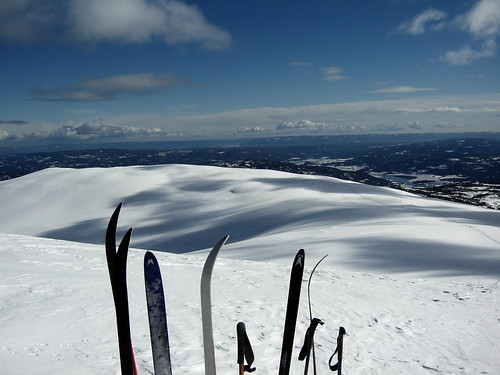
I'm back from a long weekend cross-country skiing in the mountains. Going beyond cellular coverage and wireless email really is one of the great luxuries of our age. There's something about sitting in a small cabin miles away from anywhere anyone could get a hold of you which helps you focus. Conversation seems to turn naturally towards what is important, and all the noise of the everyday fades into the background.
*
Just so you don't think I'm going all
luddite on you, I note that
the Wikipedia article on "blog" has grown a lot since I saw it last time. It has an interesting history of early blogging-section now.
*
I was listening to a part of a lecture series called "Ethics and Public Policy" just now. The lectures, made in 1991 by the funny, insightful, rambling and delightfully Jewish political philosopher Ed Beiser, concern the idea of rights and law in the public sphere. It would probably be immoral of me to suggest that
one could download the lecture series from this torrent here. Would it be legal of me to say so? Hard to say.
At one point, Beiser makes an interesting argument about what I suspect are different conceptions of rights between capitalist societies like the US and proto-socialist societies like the USSR*. He says that the conception of rights in the US is a negative conception. You have freedom of the press in the US, but the formulation is "Congress [i.e. the government] shall make no law" abridging freedom of religion, the press &tc. The freedom to assemble is the freedom to not be disassembled by the government.
The formulation of the
first Soviet constitution is an entirely different approach.
14. For the purpose of securing freedom of expression to the toiling masses, the Russian Socialist Federated Soviet Republic abolishes all dependence of the Press upon capital, and turns over to the working people and the poorest peasantry all technical and material means for the publication of newspapers, pamphlets, books, etc., and guarantees their free circulation throughout the country.
15. For the purpose of enabling the workers to hold free meetings, the Russian Socialist Federated Soviet Republic offers to the working class and to the poorest peasantry furnished halls, and takes care of their heating and lighting appliances.
So the negative conception of rights says "we won't stop you from printing whatever you like". The positive conception of rights says "here, have a printing press. The paper is over there by the ink barrels." (And in the Soviet model follows this with "here, have an oppressive military dictatorship complete with total censorship.")
It occurred to me that both these notions of freedom of the press are obsolete in their own way. The negative version is obsolete because the oppression these days comes through entirely different channels (Clear Channel & Fox News, for instance), and takes the form of oligarchic capitalism, neo-imperialism and cultural hegemony instead.
The positive version is obsolete simply because the technological revolutions made in the 17 years which have passed since the early 90s have made mass syndication and distribution available to everyone with a PC. Technology solved the problem of scarcity of mass distribution. The problem now is more the perennial one of getting people's attention. Am I right, guys? Guys?
*
The Norwegian word "Føre" is untranslatable, but is indicative of how good the snow is for skiing. Good føre is good for skiing, bad is not. It is the condition of the snow which dictates whether you are gliding in a zen-like trance across soft, light, fluffy perfection or skating roughly across an icy shell roughly the constistency of a slush puppie, which drags you backwards on uphill treks and makes you go too fast and lose all control downhill - yet somehow seems to solidify into head-crackingly hard ice when you fall. We had almost perfect føre this weekend. Føre, like weather, is also a great metaphor for conditions which dictate your actions and your possibilities, like parental mental health or world capitalism or whatever.
To belabour the metaphor: going into the wild gives your thoughts great føre, until you run out of food, at which point you start thinking more and more about the ethics of cannibalism. Fortunately, Mikkel B's cooking skills don't decrease just because he is working on a propane stove in the middle of nowhere.
*
Arthur C. Clarke died. Between him and Gary Gygax going last week, two of the central pillars of 20th century nerdhood have suddenly disappeared.
*
I made brussel sprouts poached in cider with apples and onions last night. It tastes amazing and you should try it.
This recipe is totally copied from the book I used. They just changed a sentence here and there.
Labels: arthur c clarke, blogging, blogs, brussel sprouts, free speech, freedom of assembly, gary gygax, human rights, law, mass media, rights, Soviet Union, technology, us politics, usa
