*

TWITTER | @martingruner

    16.11.09

    Tab dump 16-11-09 (though really not so much a tab dump as three-four blog posts in one)

    First off, Andrew Corsello's blistering and sublimely, viciously angry takedown of Ayn Rand. It is at least ten thousand characters too long, and not so much an article as a 26.000 character rant, but it is readable, funny, immensely satisfying and it makes a good point when it connects the dots between Randian uncritical thinking and the clusterfuck of the global economy. Highlights include this wonderfully obtuse letter to the editor from Alan Greenspan, literary critic and bigtime randroid, on the occasion of Atlas Shrugged being panned in a review.
    To the editor:

    "Atlas Shrugged" is a celebration of life and happiness. Justice is unrelenting. Creative individuals and undeviating purpose and rationality achieve joy and fulfillment. Parasites who persistently avoid either purpose or reason perish as they should.

    Alan Greenspan
    Corsello comments:
    It's a remarkable letter for two reasons. The first, of course, is that Greenspan wrote it; a line can be drawn from that letter to the wholesale deregulation of the American economy, to the invention of hydra-headed derivatives and credit-default swaps, and finally to the collapse of the financial and housing markets.
    I recently made an offhand remark about how Rand had a way of reaching nice, likeable, intelligen but maybe involuntarily celibate young men and turning them into horrible people. Morsello really captures this process. And the article ends, orgasmically, with this outburst:
    Fuck you, Ayn Rand.

    Fuck you for turning some of the most open and interesting people I ever met into utopian dickheads.

    Fuck you for injecting them with a sneering sense of superiority, and with the tautological belief that anyone who didn't "get it" was a jealous know-nothing—which, ipso facto, only proved that superiority.
    In the very last paragraph, you learn why the author is so angry. It's a nice payoff.
    *

    A fabulous interview with climatologist Stephen Schneider on climate skepticism. He also makes some really well-argued points along the way about both the injustice of the climate problem, and more importantly the entire scientific process itself. How it works, and why the climate skeptics are arguing in bad faith.
    You talk about subjectivity, but isn’t science supposed to be objective?

    No. Science is truthful, which doesn’t necessarily mean objective. How can science be objective about the future? How much data do we have for 2100? Try zero. We have data for 2009 and previous years. We take that data, analyze where we think it’s high quality, analyze where we’re not so sure of the quality, show how well the data explains multiple phenomena from the past, and ask how closely related those phenomena are to the future.


    (...)

    Once we build our climate models, we must always make a subjective judgment, because it is going to be a prediction outside the realm of direct verifiability. We have to be able to predict whether this is a potential catastrophe for humanity. We can’t just hang around and wait.

    In your book, you suggest a kind of continuum: from objective data to subjective determinations based on the data, and then to value judgments.

    Right. What to do about what we know--that’s a question of values. But it’s values informed by science. In 1973, I got a call from the Council on Foreign Relations wanting me to talk about policy. I told them that if we’re using the atmosphere as a free sewer to dump our tailpipe wastes, and it’s going to cause change that could harm agriculture, ecosystems, ice sheets, and sea level, then maybe a smart move would be to slow down the rate at which we pollute. That’s a value judgment, and I’ve been making them from the beginning. I’m a very risk-averse person and I worry much more about the planetary life support system than the bottom line of the coal industry.

    How then do you defend against charges that you’re an activist?

    I am an activist. I want the world to be a better place, and I define specifically what I mean by that: If one group, the rich, benefits from an activity like dumping their waste in the atmosphere and the other group, the poor, are hurt by it and don’t get much benefit, that’s an inequity. Therefore, in my value system, that’s a higher criteria for action than aggregate dollars. I don’t have aggregate dollars as my moral principle. I look at who’s responsible. But I never say that without admitting that those are my values. So, that’s activism.

    What’s the difference between being a climate-change skeptic and a denier?

    Every good scientist is a skeptic. In fact, I would argue that every good citizen is a skeptic. We have to learn to discern, and listen to the quality and logic of an argument.
    Read the whole thing.

    *


    For the Norwegians:

    Bergens Tidende
    har flere interessante artikler i dag om gatevold og unge frustrerte menn som er verdt å lese. Ikke minst fordi den tar opp spørsmålet om integrering og sosial kapital – for første gang på lenge ikke som et etnisk/kulturelt spørsmål, men som et sosialt spørsmål, som vi kan behandle, avgrense og møte med sosiale, politiske, økonomiske og pedagogiske virkemidler. Ikke som noe abstrakt, fremmed og fjernt. Denne serien med artikler er noe av det mest tankevekkende jeg har lest om norsk integrering på flere uker, og innvandring nevnes ikke med et ord (bortsett fra når det er snakk om innvandringsfiendtlige miljøer).

    Labels: , , , , , , , , ,

    18.10.09

    Searle's relativism

    In an attack on moral relativism and social constructivism in the New York Review of Books (not online), the famous philosopher John R. Searle writes of Jacques Derrida that he "argues ... that there is no tenable distinction between writing and speech."1

    And I, reading this, can't help thinking that Searle is being intentionally misleading. Searle engaged with Derrida on a number of occasions in well-publicised debates. He must have read a lot of Derrida, so I can only imagine that he is misrepresenting him intentionally. Why? Because that there is a profound distinction between speech and writing and parsing out exactly what that is, is inarguably one of the most central themes of Derrida's work. His early books, Writing and Difference, Speech and Phenomena, and Of Grammatology are all on this theme.

    This glaring error is just one of many holes in Searle's line of reasoning, most of which are so vast and obvious you could drive heavy machinery through them. I would have thought Searle would have understood his opponents by now, but he still doesn't. And while one can be forgiven for not understanding Derrida, whose prose style I've sometimes found more than a little irritating and obtuse, his denigration of people like Rorty and Putnam are just badly argued, thought and written. Moreover: he is definitely in a position to know better, so ignorance is not an excuse. He seems to be arguing entirely in bad faith. More on which, maybe, later. I'm guessing you're all not really in the mood for long-winded philosophy when you read blogs.

    1. The New York Review of Books, Volume LVI, number 14, p. 90

    Labels: , , , , ,

    13.11.08

    Litt frihet fra eller til

    Jonas Gahr Støre intervjues av Studentradioen. Nice going, Studentradioen. Sånne hotshots var det sjeldent vi fikk i studio da jeg drev på.

    Til åpningsspørsmålet "er menneskerettighetene bedre ivaretatt idag enn for 60 år siden" svarer Støre ja. Det er en kolossal feilvurdering som jeg nesten ikke kan forstå. Til tross for at demokrati er langt mer utbredt og at millioner løftes ut av fattigdom hvert år så er verdensforskjellene økende og siden det blir stadig flere mennesker blir det også dermed stadig flere som lever uten ressurser. 95 % av verdens befolkning lever på under $10 om dagen og 3 milliarder mennesker lever på under $2.50 om dagen. Dette innebærer en grusom og umenneskelig levestandard og sørger for at de er ute av stand til å sikre seg selv de mest basale rettigheter i FNs menneskerettighetserklæring, som for eksempel det følgende utvalget:

    Article 3.

    Everyone has the right to life, liberty and security of person.

    Article 21.

    (1) Everyone has the right to take part in the government of his country, directly or through freely chosen representatives.

    (2) Everyone has the right of equal access to public service in his country.

    (3) The will of the people shall be the basis of the authority of government; this will shall be expressed in periodic and genuine elections which shall be by universal and equal suffrage and shall be held by secret vote or by equivalent free voting procedures.

    Article 22.

    Everyone, as a member of society, has the right to social security and is entitled to realization, through national effort and international co-operation and in accordance with the organization and resources of each State, of the economic, social and cultural rights indispensable for his dignity and the free development of his personality.

    Article 23.

    (1) Everyone has the right to work, to free choice of employment, to just and favourable conditions of work and to protection against unemployment.

    (2) Everyone, without any discrimination, has the right to equal pay for equal work.

    (3) Everyone who works has the right to just and favourable remuneration ensuring for himself and his family an existence worthy of human dignity, and supplemented, if necessary, by other means of social protection.

    (4) Everyone has the right to form and to join trade unions for the protection of his interests.

    Article 24.

    Everyone has the right to rest and leisure, including reasonable limitation of working hours and periodic holidays with pay.

    Article 25.

    (1) Everyone has the right to a standard of living adequate for the health and well-being of himself and of his family, including food, clothing, housing and medical care and necessary social services, and the right to security in the event of unemployment, sickness, disability, widowhood, old age or other lack of livelihood in circumstances beyond his control.

    (2) Motherhood and childhood are entitled to special care and assistance. All children, whether born in or out of wedlock, shall enjoy the same social protection.

    Article 26.

    (1) Everyone has the right to education. Education shall be free, at least in the elementary and fundamental stages. Elementary education shall be compulsory. Technical and professional education shall be made generally available and higher education shall be equally accessible to all on the basis of merit.

    (2) Education shall be directed to the full development of the human personality and to the strengthening of respect for human rights and fundamental freedoms. It shall promote understanding, tolerance and friendship among all nations, racial or religious groups, and shall further the activities of the United Nations for the maintenance of peace.

    (3) Parents have a prior right to choose the kind of education that shall be given to their children.

    Article 27.

    (1) Everyone has the right freely to participate in the cultural life of the community, to enjoy the arts and to share in scientific advancement and its benefits.

    (2) Everyone has the right to the protection of the moral and material interests resulting from any scientific, literary or artistic production of which he is the author.

    For ikke å snakke om disse to:
    Article 2.

    Everyone is entitled to all the rights and freedoms set forth in this Declaration, without distinction of any kind, such as race, colour, sex, language, religion, political or other opinion, national or social origin, property, birth or other status. Furthermore, no distinction shall be made on the basis of the political, jurisdictional or international status of the country or territory to which a person belongs, whether it be independent, trust, non-self-governing or under any other limitation of sovereignty.

    Article 28.

    Everyone is entitled to a social and international order in which the rights and freedoms set forth in this Declaration can be fully realized.
    Problemet her er nok at Støre går i en klassisk felle som liberalere ofte gjør. Han har sannsynligvis vektlagt en forståelse av frihet som man kan kalle for negativ frihet. Det er en vanlig feil når man tenker på FNs menneskerettighetserklæring.

    Negativ frihet er et begrep som kommer fra Isaiah Berlin. Han skiller mellom positiv og negativ frihet. Negativ frihet er frihet fra, altså at ingen kommer og blander seg inn i din frihet ved å begrense dine valg. Positiv frihet er frihet til, altså at du er bemyndiget, i kontroll og handlekraftig fordi du har ressursene til å handle slik du vil.

    Klassiske liberale vektlegger gjerne negativ frihet, i tradisjonen fra John Stuart Mills On Liberty. Dermed glemmer de lett at man trenger ressurser og kontroll for å kunne uttrykke sitt eget liv slik man ønsker. Sosialister vektlegger ofte positiv frihet, og risikerer å undervurdere individets krav på frihet til fordel for statens behov.  

    Mange som tenker på menneskerettighetserklæringen tenker på de sakene som for eksempel Amnesty International gjorde seg kjent på å kjempe for: Frihet fra undertrykkelse, frihet fra arbitrær straff og fengsling, frihet fra tortur og dødsstraff. Dermed glemmer de at halve erklæringen er positive rettigheter. Rettigheten til arbeid, til helse, til utdanning, til kultur og til selvbestemmelsesrett. 

    Alle disse positive rettigheter er i elendig forfatning i størstedelen av verden, som tallene ovenfor rikt illustrerer. Skylden ligger på vår dypt urettferdige og umenneskelige fordelingssystem som avhenger av fundamentalistisk frimarkedskapitalisme og egoistisk utbytting av den tredje verden. Dette burde Støre ha sagt noe om. 

    Labels: , , , , , , , , , ,

    13.7.08

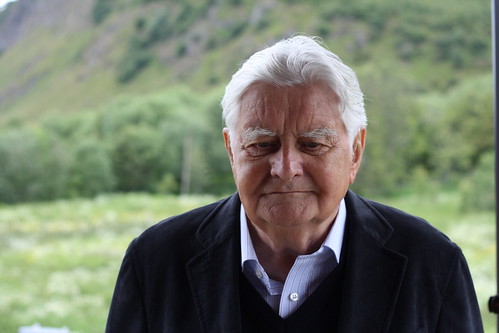
    Karl-Otto Apel

    These are the notes from my interview with the philosopher Karl-Otto Apel. Apel is 86, hard of hearing and his English is good, but with some problems. This is why some parts of the interview seem a little less coherent than others, because I had to struggle to both communicate and take notes. Note also that these are notes, not the finished interview (which is sadly only available in Norwegian). I have only edited this by inserting a few explanatory phrases here and there and filling in my own questions in italics.

    The philosopher I

    *

    - Your talk at the seminar focused on Kant's essay "Idea for a Universal History from a Cosmopolitan Point of View". What prompted you to discuss this essay?

    I was fascinated by sentence 7 of the first essay. I have never really gave attention to it, but I suddenly think to myself ”this is a strange sentence”. It's usually overlooked, but what he does here is very new: International law takes priority over the law of the republic. We can’t have internal law without solving problems external first.

    Habermas says: the structure of democracy is the same as the structure of universal law. I say no! This cannot be the case. More than one democracy and they don’t have same structure. E.g. law of asylum are all different. US didn’t want to enter the International Criminal Court. Refused it. This is one of the typical deficiencies of international crime and human rights. In many other respects also we have differences between different democracies. They will not quickly have same constitution! I would say against Habermas and Rawls also that it must be possible to intervene in single democracies in the name of human rights. Appealing to human rights.

    - You mean militarily?

    Maybe even militarily, but usually it will be much more quiet.
    Every day news about human rights discussions with for instance Iran or China. I mean in the sense of publicity, media, discussions, also. Habermas does this first book – this is for him the paradigm of Universal law.

    This is problem between pragmatic differences go into these constitutions. This is characteristic aspects of lack of cosmopolitan law. Many problems that have to be solved in quite different ways. In Europe now the problems of immigration from Africa, Turkey in Germany, France from Algeria. Spain, these problems of immigration of poor people from Africa. Has to be settled by constitutions. This would be better if we had sensible agreements. European countries come to agreement on how to deal with these people who sometimes die on the ocean heading to [unintelligble]. Just one example to show that this has to be settled. Raison d’etat of the different countries needs to come to agreement.

    - A consensus?

    Consensus is central issue in my philosophy and Habermas. Consensus theory of truth, not factual, but ideal consensus in the sense of Peirce. Only idea, never be ultimate consensus that disables criticism and objections.

    - An idea to work towards?

    In my philosophy regulative ideas are important. Alternative: metaphysics, platonics or lack of any idea of progress at all. I don’t want progress in the sense that postmodernists deny as if we could have knowledge of the future, but we could have regulative ideas, for instance that of Kant's world citizen. We will never have the moment where there can never be an improvement. This is the great possibility for the regulative ideas. Richtsmass [sp.?] = Kant = measure for the direction we have to go in search for truth or philosophy or science. We need regulative ideas in all these things. Not metaphysical knowledge. These can be found by practical reason. It is our duty, Kant says. Burden of proof is on us.

    Also I would say regulative ideas is not the same as a utopia. That’s more of a alternative picture of the world. More a matter for poets and literature. They are less than a utopia, not so concrete. But on the other hand they are much stronger, because they are more serious.

    - In your talk, you described the situation for international law as "aporetic". In what sense do you mean?

    Goes back to Kant in a sense! It’s all aporetic. If not everything is lost, we have only the possibility of a negative surrogate. He has the feeling that he is working on an aporia. He writes...

    First: We need to leave the state of nature, strong state for all people.

    Then: No, it would destroy the autonomous states. They will never accept that.

    After the first world war when the league of nations was founded. Woodrow Wilson one of his strong words was autonomy of the nations. He wanted the Kantian situation: a folkeforbund. Kant wanted a federation of republics, not monarchies! But he was not against monarchs as governors, but he should respect the republican constitution. A matter of transition in the 18th century.

    Frederik the Great: ”Only greatest servant of the state”, although he was not the ideal man of Kant. First war he started: ”Why did I do that? In order to come into the gazetten [newspapers].”

    Approximation was always connected to the idea of regulative ideas. Is a difficult problem to think of approximation. Progress is aterrible problem. From our point of view we can say something was a progress, but in potential infinity? I’m not a follower of Kuhn.

    - Kant wanted a federation of republics. What do you want?

    I can’t say if it will be the case, or what we should do, but I do think we should continue to do certain things. We should support the UN. Make it stronger. It is not strong enough today. The five world powers in the sec.coun. are not republics. Complete historical accident. Constantly it is discussed. The Brazilians, Nigerans, Germans, all want to become constant members of the sec.coun. Best we can hope for. It is an ambiguity. One of the members of the seminar said he wants a world state. Another said we have so many problems that are global in nature, so we need a world of state.

    I wrote a paper on this in Spain whether the US should be the world power. It was too much for me. There were too many arguments against an empire.

    The Roman empire had human rights, in a sense. Apostle Paulus was proud. But the Romans did not tolerate others.

    - Are empires dangerous in themselves?

    I am a historian. I must think of examples. Let me think:
    If one looks at the Chinese history: Today China is very powerful, but in history there were times that China was the only real state, and the only superpower. From their point of view in Eastern Asia they were an empire. Never been any example of an uncontested empire.

    We have not an empire in our current situation, but now with Iraq we have one. The US has hegemony and superpower and the most powerful technology. I was against [Iraq]. Burned with lie and veto of the other members of the council.

    It is ambigious what Kant says. The only idea of reason can be a world state, but no, they will never accept it, it can become a tyranny. A cemetery of freedom. A soulless despotism.
    A round planet, he says. All human beings have the same right to visit any place on this planet. A common planet. But what happened in our history. The Europeans in the age of colonization. The Japanese didn’t allow them. They didn’t want to become colonized.
    Pope asked for forgiveness.

    - You have delved into international law now. Where else is your philosophy going?

    My philsophy is declining. In these last years, everything went down. My body and my memory, ach. They don't work. It doesn’t become better as we get older. First I did not even think I would come here now, attend this conference. But I know so many people here I want to see again. It's good, but it is too much.

    The philosopher II

    *

    [long pause where we just talked]

    Arne Næss is still alive?! A fellow once had this idea that [Norwegian philosopher and mountain climber and 96-yr-old] Arne Næss should climb up to the top of a mountain and discuss. But I lost my breath. Did not even get half-way. So then we should discuss over dinner instead, and we both had a glass of red wine and a nice meal and things were good. And so, we should discuss, but Næss grew sleepy and we never got to discuss!

    (...)

    It's very strange how far apart Habermas and I have grown. He is much closer to the view of Richard Rorty now, which I think is unfortunate. Reading his latest book, there is a homage to Rorty, who died. It appears that there are almost no disagreements between them any more.

    Labels: , , , , ,

    22.2.08

    Et tu, Brute

    Here's an 8-part lecture on the philosophy of mind, given by John Searle. I've only seen the first bit (I'll watch the rest if I get the time), but it seems like a nice introduction to the field.

    He gets into what he has earlier called the "brute fact vs. social fact" distinction at the end of part 1. This brought up something I was reading about that distinction last year around this time, as I was finishing up my MA thesis. This is how I remember it:

    The brute facts are the world, independent of the observer. The social facts are facts that depend on social decisions and, I guess, aesthetics: matters of taste, in the broadest possible sense (what to do: commit mass murder or have a nice cup of tea?).

    You kick a rock, Newton says, the rock will brutalise your foot. The rock and its physical nature is a brute fact which bruises your foot. The physical pain is a brute fact too, probably - neural signals and responses. But what the pain means is a social fact. It depends on you and your community's relationship to physical pain and/or rocks.

    In general, as a rule, I think we can almost never go wrong if we assume that most facts are social facts. Even things which seem very obviously to be brute facts, like said rock, are, when you think about it, crawling with social facts: what do you think about rocks? What do you think about pain? Why do you kick the rock? Have you kicked rocks before? Does the rock remind you of your mother? Etc. Etc.

    Michael Bérubé has an argument which I think I agree with in his book Rhetorical Occasions that the distinction between what is a brute fact and social fact is a social fact, in the day-to-day business of being alive. If you believe the rock is an illusion, the rock doesn't stop being a brute fact, and if you change your mind upon having kicked it, it doesn't care. But in the interaction with your community, there is no solid basis to ever completely arbitrate the dispute over what is a brute fact and what is a social fact. You can change your community's mind, but their state of mind is generally much further from the brute facts than one would think.

    I mean, kicking the rock is a pretty damn convincing argument, but it's still rhetoric.

    Labels: , , ,

    7.2.08

    Ex-blogger (oh, and professor or something) Michael Bérubé has written a 9-page essay on the event of Richard Rorty's death which I'm looking forward to reading. It's called "Richard Rorty and the Politics of Modesty" (pdf).

    Re: the first paragraph:
    Have you ever noticed that when people are writing about the recently deceased, they always begin by using the full name even though the person in question didn't Richard Rorty becomes Richard McKay Rorty, and Ronald Reagan (no similarity implied) becomes Ronald Wilson Reagan. There's something ritualistic in the public declaration of death. The use of the fuhttp://www.blogger.com/img/gl.link.gifll name accentuates the individuality of the deceased as well as the formality of the event. I wonder if that isn't one of the oldest functions of the public sphere: the public declaration of birth and death, habeas corpus, non habeas corpus, bring out yer dead.

    Oh, and Bérubé is also going for Obama. Yup. Me, Bérubé, Stevie Wonder, Josh Lyman and Oprah.

    Labels: , , , , ,

    29.1.08

    Dying in front of the lens

    Suitcases belonging to Robert Capa, containing thousands of negatives from the Spanish Civil War have been found. Certain members of the Larsen family who have written profusely on the question of the authenticity of the "Falling soldier" picture are no doubt thrilled.

    *

    In other, photography-related linkage, this video shows how a camera lens is made. It's an intricate process, taking six weeks. What I like most about it is how messy the process seems, but how perfect the result is.

    When the philosopher Baruch de Spinoza wasn't writing huge, monumental works of philosophy, he was a lens grinder. Put another way, he was a lens-grinder who wrote philosophical books. He died of phthisis - tuberculosis caused by inhaling irritants: fine, glass dust.

    Labels: , , , , , , ,

    9.6.07

    Richard Rorty (1931-2007)

    Richard Rorty died yesterday from pancreatic cancer.

    I don't really know what to say. Rorty is probably the thinker who has influenced me the most. I first read him in Ralph Jewell's amazing seminars on the poetics of science when I took a grunnfag in philosophy. When I was re-reading him for my MA thesis, I became acutely aware of how much his thinking had seeped into the foundations of my world-view.

    For more about Rorty, you can actually just check out the last couple of paragraphs of the previous post.

    Update:

    Some places to start with Rorty.

    First, try reading this introduction to Consequences of Pragmatism from 1981. Here, Rorty gives a brief outline of how pragmatists think, and what the consequences of that position is. It's a good place to begin, and it's a way of determining if you like Rorty's whole approach to philosophy. I think one should not completely assimilate Rorty, and take all things which he say to heart. He is fuzzy on a lot of practical issues, and simplifies a lot of problems (possibly for rhetorical reasons - he is an eminently rhetorical philosopher). The most important thing one should take from him is the basic approach, I think. The way he makes things contingent and takes the consequences of a godless world to their last stop, and tries to create a practical philosophy in that position. He refuses throughout his bibliography to say that he is right, that he speaks the truth, and that this does not mean that he cannot make ethical judgements:

    Pragmatists think that the history of attempts to isolate the True or the Good, or to define the word "true" or "good," supports their suspicion that there is no interesting work to be done in this area. It might, of course, have turned out otherwise. People have, oddly enough, found something interesting to say about the essence of Force and the definition of "number." They might have found something interesting to say about the essence of Truth. But in fact they haven't. The history of attempts to do so, and of criticisms of such attempts, is roughly coextensive with the history of that literary genre we call "philosophy"-a genre founded by Plato. So pragmatists see the Platonic tradition as having outlived its usefulness. This does not mean that they have a new, non-Platonic set of answers to Platonic questions to offer, but rather that they do not think we should ask those questions any more. When they suggest that we not ask questions about the nature of Truth and Goodness, they do not invoke a theory about the nature of reality or knowledge or man which says that "there is no such thing" as Truth or Goodness. Nor do they have a "relativistic" or "subjectivist" theory of Truth or Goodness. They would simply like to change the subject. They are in a position analogous to that of secularists who urge that research concerning the Nature, or the Will, of God does not get us anywhere. Such secularists are not saying that God does not exist, exactly; they feel unclear about what it would mean to affirm His existence, and thus about the point of denying it. Nor do they have some special, funny, heretical view about God. They just doubt that the vocabulary of theology is one we ought to be using. Similarly, pragmatists keep trying to find ways of making anti-philosophical points in non-philosophical language. For they face a dilemma if their language is too unphilosophical, too "literary," they will be accused of changing the subject; if it is too philosophical it will embody Platonic assumptions which will make it impossible for the pragmatist to state the conclusion he wants to reach.
    And also the following, oft-quoted passage:

    Suppose that Socrates was wrong, that we have not once seen the Truth, and so will not, intuitively, recognise it when we see it again. This means that when the secret police come, when the torturers violate the innocent, there is nothing to be said to them of the form "There is something within you which you are betraying. Though you embody the practices of a totalitarian society which will endure forever, there is something beyond those practices which condemns you." This thought is hard to live with, as is Sartre's remark:

    Tomorrow, after my death, certain people may decide to establish fascism, and the others may be cowardly or miserable enough to let them get away with it. At that moment, fascism will be the truth of man, and so much the worse for us. In reality, things will be as much as man has decided they are.

    This hard saying brings out what ties Dewey and Foucault, James and Nietzsche, together- the sense that there is nothing deep down inside us except what we have put there ourselves, no criterion that we have not created in the course of creating a practice, no standard of rationality that is not an appeal to such a criterion, no rigorous argumentation that is not obedience to our own conventions.


    If you want to read a book-length work, Contingency Irony and Solidarity is probably the best introduction to his thinking. It's a very easily read, deceptively simple book. The argument of the book is basically an attack on foundationalist conceptions of language, self and community (a negative project); followed by an attempt to construct political and personal possibilities after taking those conceptions apart (a positive project).

    First, he attempts to think of the language we use not as a device becoming better and better suited to the world around us, but as a tool for interaction with other human beings. Second, the idea of the self becomes an attempt at redescription of culture in a historical setting. Third, the idea of community becomes a rhetorical element. A set of arguments and descriptions of how certain institutions and ideas of community arose.

    In chapter 4, he lays out the political possibilities for the ironist mindset which arises from these contingencies. The ironist is the personality Rorty has the most respect for. A humanist who is never quite able to take himself entirely serious, and is therefore never sure of his own rightness. These people are easily convinced of the right of other people to express their own ways of life, and hard to convince that certain rules should be made to be unbreakable and non-negotiable.

    Next follows some readings of cranky old continental philosophers and Derrida, and readings of authors Proust, Nabokov and Orwell of which particularly the Orwell chapter is interesting. There, he basically argues that one of the lessons to take from Orwell is that characters like O'Brien in 1984 are possible. That we might at one point step off the wheel of history at the wrong place, and that one should never give up the diurnal struggle. All it takes is one bad generation before the torturers come knocking. And this is the vision which Rorty attempt to create an apparatus to prevent, O'Brien's vision of history. As an intellectual of the party, he can say the words with a straight face, as something to be desired: "If you want a
    picture of the future, imagine a boot stamping on a human face--for ever."

    And as Winston pleads with him to convince him that such a society is impossible, he appeals to the Spirit of Man, and O'Brien tells him that if Winston is a man, he is the last one. That he is about to become extinct.

    Labels: , , , ,

    8.6.07

    Cultural pessimism and pragmatic optimism

    I’m sorry for the long-windedness, but what follows is an incredibly long post which I’ve been sort of writing by accumulation, a line here, a paragraph there, since at least February. Now it’s just been sitting on my hard drive for three weeks and Baudrillard shuffled off this unreal mortal coil and Lovink just got quoted about his view of blogs in Morgenbladet, so it has some topical urgency, so I might as well just post it. But it is a bit of a patchwork creature.

    Ok, so let’s talk a bit about cultural pessimism. As I mentioned in a previous post, the thing I found most useless about the thinking of Jean Baudrillard was his constant pessimism. Surely, one would think, the first task of any branch of theory or philosophy is to create working conditions and conceptual frameworks for praxis. If a theory doesn’t help you live your life in some way, or doesn’t lead on into something which is helpful to you in some way, then it is by definition not worth spending time on. (Though it might be interesting pursuing it, if one thinks it might eventually lead to something useful, or even if one thinks it’s merely interesting, one should pursue it. Often, something which one thought was unimportant or mostly irrelevant turns out to be important and practically useful 80 years down the line, like for instance matrix mathematics. This is the short version of the defence of basic research in the natural sciences, without which we wouldn’t have the theory of relativity or the atomic bomb.) Obviously, there should be as wide a range of possible values of “helpful” or “your life”, but in the end, if a philosophical system makes you want to lie down and die, or sit in your office and smoke cigarillos all day, while writing incomprehensible essays on how things used to be so much realer, then that would seem to me to be the definition of bad theory.

    I always wonder, with people who claim in their writings that everything is useless, that nothing can be done, etc.: why do they write at all? More to the point: why do they publish? If everything is useless, why spread the word? Isn’t that spreading of the word actually an act of violence and malice? Wouldn’t the thing to do be to shut up about it? Keep people in a state of ignorant pseudo-bliss? No, if you publish philosophy, theory or whatever at all, there must be a rhetorical imperative. What are you trying to do to the reader? What political action are you trying to provoke? What change in mindset?

    So I consider the imperatives of theory and philosophy are to find private methods of dealing with the existential situation that comes after the death of God and the birth of modernity and finding public political strategies for creating new and better (“better”) ethical regimes in that situation. Also, if they can help us have a little fun along the way, that would be great.

    *

    Which is just a preamble for talking about this article: “Blogging, the nihilist impulse” by Geert Lovink. Ever since Audun L mailed me the link, I’ve wanted to respond to this take on blogging. Lovink is following in the footsteps of Baudrillard not least by exhibiting a strange pessimism of new media, and manufacturing negative attributes in them. The article has a view of blogs which I can't identify with, but seems to me to be an excellent example of cultural pessimism in action.

    “It is of strategic importance to develop critical categories of a theory of blogging that takes the specific mixture of technology, interface design, software architecture, and social networking into account”, Lovink begins, and I wholeheartedly agree (although I’m not entirely sure what "critical categories of a theory of blogging" really means), until I read the follow-up:

    Instead of merely looking into the emancipatory potential of blogs, or emphasizing their counter-cultural folklore, I see blogs as part of an unfolding process of "massification" of this still new medium. What the Internet lost after 2000 was the "illusion of change". This void made way for large-scale, interlinked conversations through freely available automated software.


    You're just skipping along through the paragraph and... wait, what? The illusion of change? As if to say that now, of course, we are no longer blinded by this illusion. The internet has not changed our lives. All that change was just an illusion. Of course the sudden proximity of all text, the ability to sift through vast seas of information in seconds, the ability to textually communicate meaningfully over vast distances in seconds, all this is just an illusion of change, not actual change. Our cultures are exactly the same. When actual change comes along, I presume, we’ll really feel it. But, then, actual change won’t come, because here comes Baudrillard to harsh our mellow:

    blogs were the actual catalysts that realized worldwide democratization of the Net. As much as "democratization" means "engaged citizens", it also implies normalization (as in setting of norms) and banalization. We can't separate these elements and only enjoy the interesting bits. According to Jean Baudrillard, we're living in the "Universe of Integral Reality". "If there was in the past an upward transcendence, there is today a downward one. This is, in a sense, the second Fall of Man Heidegger speaks of: the fall into banality, but this time without any possible redemption." If you can't cope with high degrees of irrelevance, blogs won't be your cup of tea.

    Here, I think, we see the beginnings of a nihilist anti-democratic school of thought which I think is the last stop of the Baudrillard train. There is a claim of celebrating a difference and subjectivity now lost, but at the same time there is an attack on the material conditions necessary to allow real difference to be actualised and flourish, coupled with what amounts to an attack on actual difference in the world today, because it is not “real”, not “genuine” enough. Down this road lies an aristocratic, and possibly even protofascist way of thinking, where somebody gets to decide real modes of living vs. unreal.

    But here the contradictions begin. Further down, Lovink laments that “a dominant culture, such as the Californian techno-hippies, failed to emerge and if it exists, it is tricky to label” and that “Blogging comes close to what Adilkno once described as "vague media". The lack of direction is not a failure but the core asset.” So what exactly is it: does one want normalization or a non-vague media? Fact is that people are vague, when taken all together. Individually, they are engines of difference, producing the plurality of cultures. Any media which is democratic is also vague, when seen as a totality. When seen individually, in its production, however, it is something else entirely. The acknowledgement that all value shades into vagueness when a large enough sample is taken is lacking here. (This part-whole dialectic, btw, is something which runs through the entire study of blogging, in my experience.)

    So there is a bait-and-switch here: on the one hand Lovink is saying that blogging means irrelevance, banality and the eradication of difference, on the other hand, he himself overlooks and smoothes over the difference which is actually found in blogs by using these massive generalisations which pervade the article (claiming that there is a cynicism folded into the media, for instance, or statements on the general form of blogs are this, blogs are that which he sprinkles liberally throughout). He does not allow blogs to enact the difference he claims that they eradicate, because he describes in homogenic terms a heterogeneous phenomenon.

    Furthermore, the claim of banality and nihilism is more of a problem than the phenomenon itself. Blogs are a media, not a genre (as Lovink acknowledges, but fails to incorporate into her argument). When they are used properly, they are tools that help you generate meaning. Used properly, they can be the opposite of banality: the establishing of meaning and relevance in everyday life, in one’s textual universe, one’s experiences, etc. So when Lovink says that a high degree of irrelevance is the scourge of blogging, what I see is the ugly head of instrumental reason rearing itself. It demands the question: irrelevant in relation to what? To what end? We’re all doomed to banality anyway, right? No: life is irrelevant. Books are full of the irrelevant. Art is completely irrelevant. Desiring relevance and meaning in everything is precisely the force which renders life in modernity meaningless and instrumentalised. To paraphrase Tom Stoppard, if things being rational were a criterion for their being allowed to exist, the whole world would be a soy-bean field. This is the very force which one should be opposing, and which blogs can be a weapon against when used right.

    What I think the real problem here is, is that Lovink simply hasn’t read enough blogs. His sample size seems too small, when I think of the enormous difference of blogs I have come across in the course of writing my thesis. I think he has read a couple of “representative” ones, and called it a day, ignoring the wild proliferation of modes of blogging which exist in the shade of the A-list bloggers. When he talks about the “almost self-evident equation between blogs and the news industry”, I think to myself: this person has never read any of the blogs I read regularly. Or this little chestnut: “To "blog" a news report doesn't mean that the blogger sits down and thoroughly analyzes the discourse and circumstances, let alone checks the facts on the ground. To blog merely means to quickly point to news fact through a link and a few sentences that explain why the blogger found this or that factoid interesting or remarkable, or is disagrees with it.” This is nonsense, and all the best bloggers know it (even most of the bad ones know it, they just lack the ability to do it). While some bloggers are into the link + commentary school (Jason Kottke is one of the most interesting ones), good blogging is pretty much the same as good analysis, good content. Further down, Lovink says “Bloggers rarely add new facts to a news story. They find bugs in products and news reports but rarely "unmask" spin, let alone come up with well-researched reports.” And if this has not been proven thoroughly wrong by the political history of blogging, already (I think it has), surely it will be.
    The London Times noted that Houellebecq "writes from inside alienation. His bruised male heroes, neglected by their parents, cope by depriving themselves of loving interactions; they project their coldness and loneliness on to the world." Blogs are perfect projection fields for such an undertaking.
    Yes, but the point is that it’s perfect for almost any communicative action that happens over a certain amount of time. It’s perfect medium for creating loving, meaningful, collective interactions as well.
    So far it has not proven useful to interpret blogs as a new form of literary criticism. Such an undertaking is bound to fail. The "crisis of criticism" has been announced time and again and blog culture has simply ignored this dead-end street.
    Actually, I disagree extensively in my MA thesis, for certain values of literary criticism, anyway.

    Criticism has become a conservative and affirmative activity, in which the critic alternates between losses of value while celebrating the spectacle of the marketplace. It would be interesting to investigate why criticism has not become popular, and aligned itself with such new-media practices as blogging, as cultural studies popularized everything except theory. Let's not blame the Blogging Other for the moral bankruptcy of the postmodern critic.
    Yes. Criticism celebrates the marketplace. I can hear them shouting now. “All hail the marketplace!” Judith Butler sings, with Hardt and Negri on backing vocals. “Glory to the almighty dollar”, Jacques Derrida calls out from beyond the grave, in his silver-lined coffin. But beyond this incredibly weird statement, the empirical problem returns once again, because criticism has aligned itself with blogging. Extensively, actually, all across the world. For one example, one could point to the cluster of popular blogs around the Valve, containing people like Michael Bérubé, Scott Eric Kaufman, Bitch Ph.D, etc. and so on and so forth (there are hundreds of them, thousands).

    “One thing is sure: blogs do not shut down thought.” Well, thank the Free Market Forces! But what is thought, to cultural pessimism? There is a sense here, I think, in which thought can be had in a vacuum. Lovink concludes her article: “Isn't the document that stands out the one that is not embedded in existing contexts? Doesn't the truthness lie in the unlinkable?” And I wonder to myself how we would find a document that was not embedded in existing contexts. How we would read it. The answer is that we can’t. All rhetoric, all language, depends on having a set of contexts, which are known, and a set of unknown or new elements, either in the combination of old elements or the adding of new ones. The truthiness, or whatever he calls it, lies in communities, in contexts and settings which relate frames of meaning that we can work from. But Lovink is arguing precisely that bloggers have lost faith in their communities’ transcendental meaning. Truth is not to be found, and that's the point. Especially not in places where it can't be found. Text is culture talking to itself. And the truthiness is just not to be found:

    A cynic, so Sloterdijk says, is someone who is part of an institution or group whose existence and values he himself can no longer see as absolute, necessary, and unconditional, and who is miserable due to this enlightenment, because he or she sticks to principles he or she does not believe in.
    But this is precisely where my brand of postmodernism parts way with Baudrillard and Lovink (and is why, I suspect, that Baudrillard is the opposite of a postmodern thinker. Is in fact a conservative pre-modernist trapped in a postmodern time). I think that the act of blogging could be or is a confirmation of community. Or rather that it is an action which is partially constitutive of a community. By throwing communication out there, with trust, one creates conversations which do not orientate, as Michael Bérubé has argued in his book Rhetorical Occasions, towards consensus, but which create meaning and political will.

    No, I’m more in the camp of the pragmatists on this one. The philosopher Richard Rorty calls such a person as the one Sloterdijk describes above an ironist, not a cynic, and constructs a positive position out of the ironist self-description. He shows, in my opinion quite well, how the act of constructive redescription is the generating force in postmodern, “nihilist” society (Simon Critchley has described Rorty as a “passive”, accepting nihilist, but I think on the contrary that Rorty has demonstrated precisely an active will towards the pragmatic, political constructivism which I hold to be a goal of philosophy, and hold his project, on a whole, to be a constructive, political one).

    In conclusion, though, I see this article as a very precise statement of the principles of cultural pessimism. Lovink writes,
    What's declining is the Belief in the Message. That is the nihilist moment, and blogs facilitate this culture as no platform has ever done before. Sold by the positivists as citizen media commentary, blogs assist users in their crossing from Truth to Nothingness.
    Cultural pessimism’s mode of operation is to attack tools of great possibility on a weak basis. The focus is on the destruction of tools, rather than inventing positive ways of using them to create meaningful cultural constructs. Why doesn’t Geert Lovink just get a blog and try to change the subject instead of spouting negative commentary from the sidelines? It doesn’t make sense. Instead, this brand of pessimism undermines a nuanced, rigorous critique of media (or, I suspect, whatever it happens to be attacking: globalisation, humanism, etc.), by eliminating all positive positions from which a new vision of its object of attack can be created. Instead of constructive, pragmatic redescription of faulty or flawed concepts, we get pessimist destruction of options. It simply does no one any good. If the blogosphere has problems (and it does, it's a product of a flawed culture), then the critique needs to be more rigorously constructive than Lovink.

    Labels: , , , , , , , , , , , , , ,

    19.2.07

    Humor

    An open source philosophy experiment:

    Why are things funny?

    Like, say, the following two conversations:

    - How's our mutual friend X?
    - He's fine... NO I'M JUST KIDDING, HE'S DEAD! HA HA HA HA.

    Or

    - How's our mutual friend Y?
    - He's dead.
    - Oh, God, really??!
    - NO, I'M JUST KIDDING! HA HA HA HA.

    If they actually happened, they wouldn't be funny, except for the amusing gentleman who is the jokee. The joked, however, is not amused. Wherein lies the quintessential fun-ness of jokes?

    Labels: , ,